
E-Trike Rack vs. Platform Rack: Why a Multi-Use Carrier Gives You More Options
When shopping for an e-trike rack, the first question is usually pretty simple:
Will it carry my e-trike?
That's obviously important—but there's another question worth asking:
What can the rack do when you're not carrying your e-trike?
Many traditional e-trike racks are designed for one primary purpose: transporting an e-trike. They may do that job very well, but when the trike isn't on the rack, their usefulness is limited.
A platform-style hitch carrier takes a different approach.
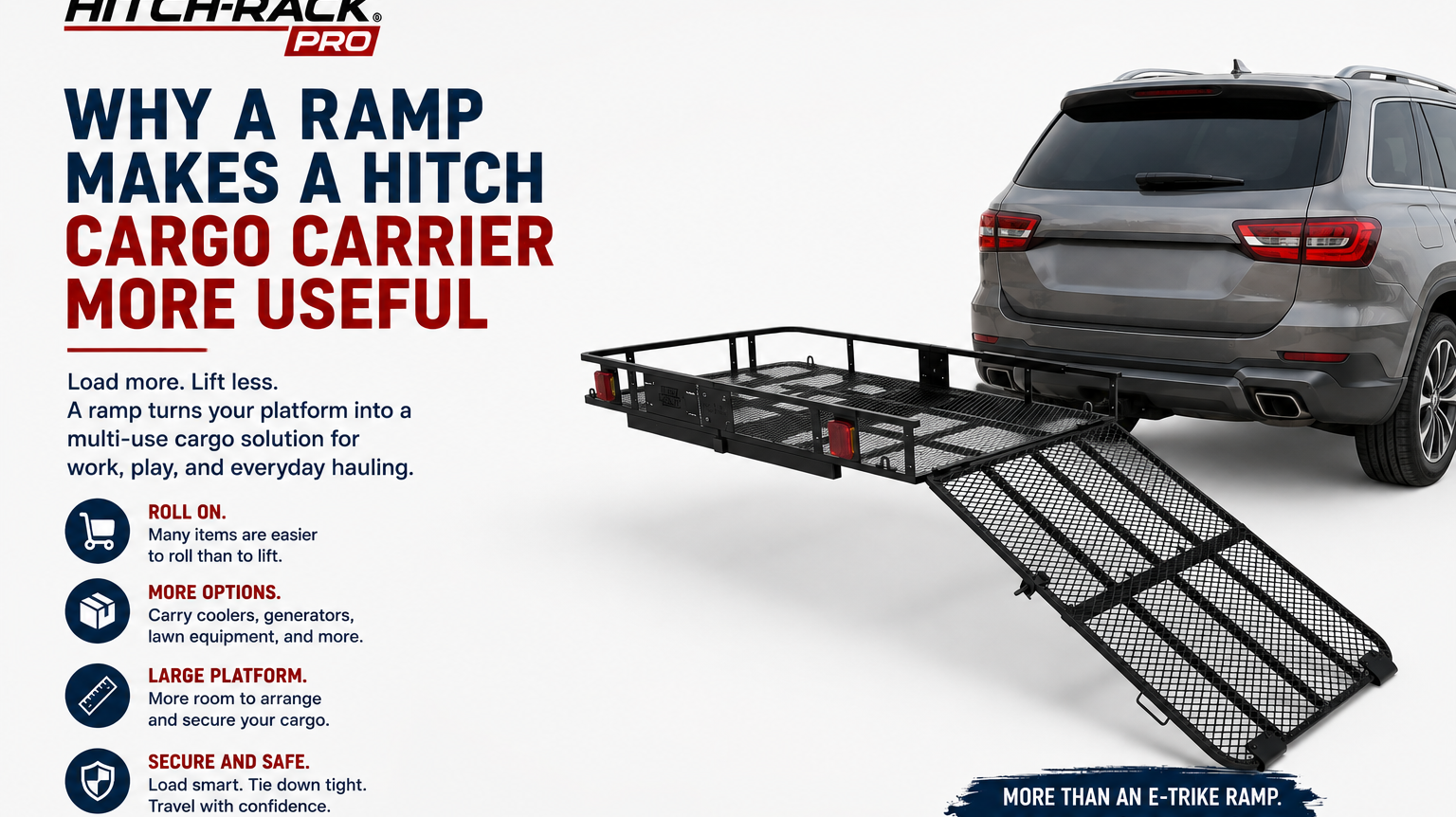
With a large, open platform, the carrier can transport an e-trike when you want to ride—and potentially handle other types of cargo when you don't.
That makes the platform more than an e-trike rack.
It becomes a multi-use hitch carrier.
What Is a Traditional E-Trike Rack?
Most purpose-built e-trike racks use wheel trays, rails, or cradles positioned specifically for the three wheels of an electric trike.
This design has an obvious advantage: everything is arranged around the trike.
Depending on the rack, wheel positions may be adjustable to accommodate different trike dimensions.
But the specialized design can also have a disadvantage.
Remove the e-trike and you're left with a rack primarily designed to hold three wheels.
If you want to carry coolers, camping equipment, storage containers, tools, or other bulky cargo, those wheel trays may not provide a useful cargo surface.
It's a specialized solution for a specialized job.
What Is a Platform E-Trike Rack?
A platform carrier starts with a different foundation.
Instead of building the carrier primarily around individual wheel trays, it uses a large platform surface behind the vehicle.
The e-trike can be positioned and secured on that platform when you're transporting it.
But when the trike comes off, the platform remains useful.
That's the important difference.
You're not just buying space for three wheels. You're adding usable carrying space behind your vehicle.
One Carrier, More Than One Purpose
Think about how you actually use your vehicle throughout the year.
Maybe you're transporting your e-trike this weekend.
Next month you're going camping.
Later you're taking a family road trip.
Then you have a home improvement project.
A dedicated e-trike rack may spend most of those trips sitting in the garage.
A platform carrier has the potential to remain useful.
Depending on its specifications and the load being carried, a platform-style hitch carrier can provide space for items such as:
-
Coolers
-
Storage totes
-
Camping gear
-
Luggage
-
Outdoor equipment
-
Tools
-
Supplies
-
Other bulky cargo
And when it's time to take the e-trike somewhere, the same platform goes back to carrying your ride.
That's what we mean by multi-use.
The Advantage of a Full Platform
A large platform provides something individual wheel trays can't:
continuous usable surface area.
That's valuable when you're carrying items that aren't bicycles or trikes.
A storage tote doesn't have wheels that line up with bike trays.
Neither does a cooler.
Camping equipment doesn't care where your wheel cradles are positioned.
A platform gives you a general-purpose surface that can accommodate many different types of cargo, provided the load can be appropriately secured and remains within all applicable specifications.
That versatility can make the carrier useful much more often.
More Cargo Space Without Filling the Vehicle
Anyone who has packed for a road trip knows how quickly interior cargo space disappears.
Add passengers, luggage, coolers, camping equipment, or other gear and suddenly every inch matters.
A hitch-mounted platform can move suitable cargo outside the passenger compartment.
That may free up interior space for people, pets, luggage, or other items you'd rather keep inside the vehicle.
For SUVs and crossovers in particular, additional external cargo space can be extremely useful.
A Platform Carrier for Camping
Camping is a great example of where a multi-use platform can earn its keep.
You may have:
-
Coolers
-
Storage totes
-
Folding chairs
-
Tents
-
Outdoor equipment
-
Firewood or other permitted supplies
-
General camping gear
Some of those items can take up a surprising amount of space.
A platform carrier can provide another place for suitable equipment while preserving interior cargo space.
Then, on a different trip, the same carrier can transport your e-trike.
Instead of owning one product for the trike and another for cargo, a multi-use design may allow one carrier to serve both roles.
Useful for Road Trips Too
You don't have to be camping to run out of room.
Family vacations and long road trips can quickly fill an SUV or crossover.
A hitch platform can provide additional carrying space for properly secured cargo.
That can be especially helpful when the interior needs to remain comfortable for passengers.
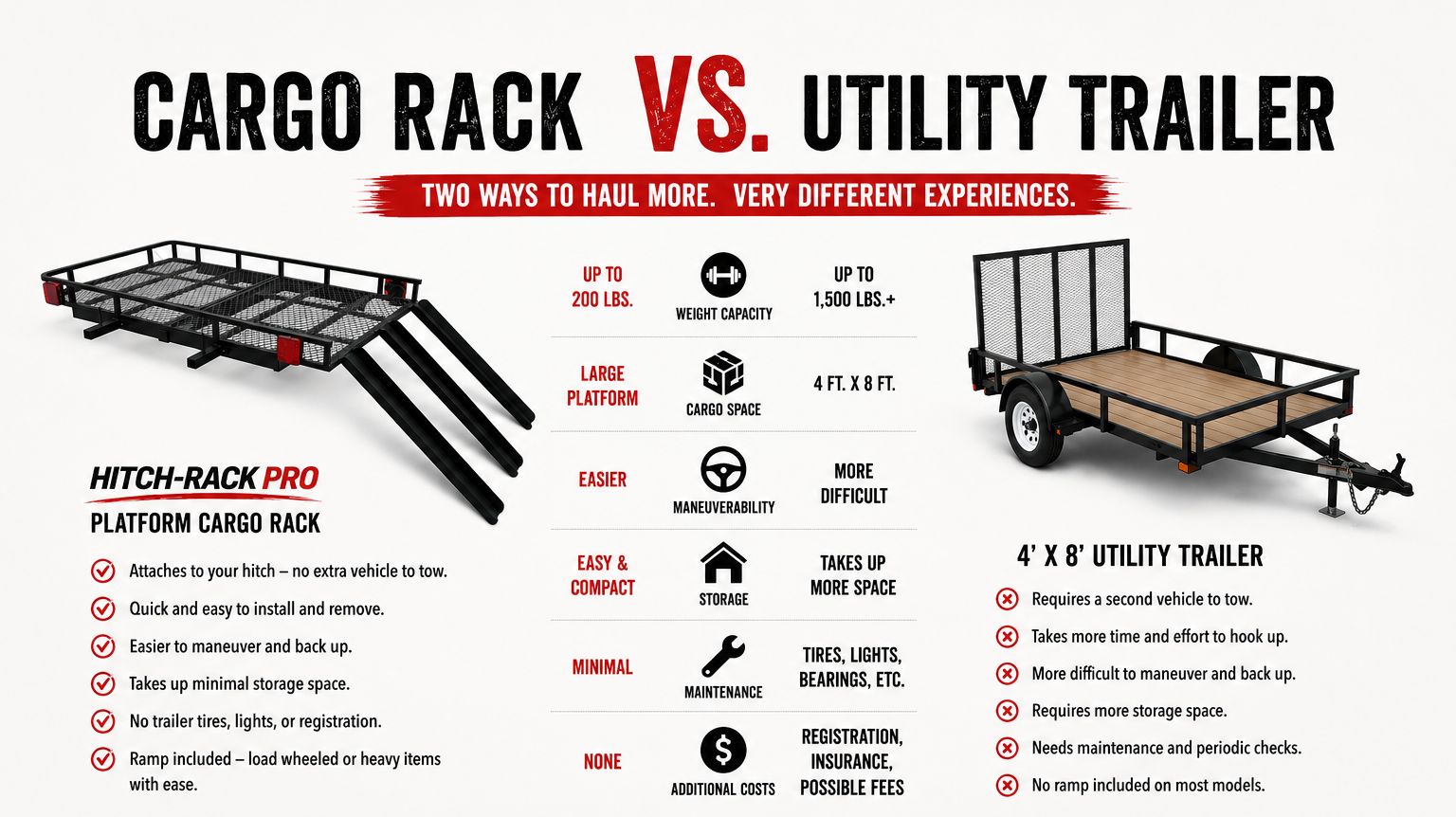
And unlike a trailer, a hitch-mounted platform doesn't add another axle and set of wheels behind the vehicle.
For people who want additional cargo capacity without towing a trailer, that can be an attractive option.
What About Around the House?
The usefulness of a platform carrier doesn't end with recreation.
There are plenty of situations where additional cargo space behind the vehicle can come in handy.
Trips to the hardware store.
Garden supplies.
Tools.
Bulky boxes.
Outdoor equipment.
Items you'd rather not put inside the vehicle.
The exact cargo you can transport depends on the dimensions, weight, securement requirements, and carrier specifications.
But that's the point of starting with a platform:
The carrier isn't limited to one predetermined shape.
Dedicated E-Trike Rack vs. Platform Rack
A traditional e-trike rack can be an excellent choice if your only goal is transporting an e-trike.
Its specialized wheel supports may make it compact and purpose-specific.
But if you want your hitch-mounted equipment to serve additional purposes, a platform design deserves consideration.
The difference can be summarized pretty simply:
Dedicated e-trike rack: Designed primarily around the wheels and dimensions of an e-trike.
Platform e-trike carrier: Provides a surface for transporting an e-trike while retaining the ability to function as a general-purpose cargo platform when appropriately configured.
Neither concept is automatically right for everyone.
The better choice depends on how you plan to use the carrier.
Think About How Often You'll Actually Use It
This is an important question when comparing racks.
Suppose you transport your e-trike twice a month.
What happens to your carrier during the rest of the month?
With a highly specialized rack, the answer may be:
Nothing.
With a multi-use platform, the answer could be very different.
You may find yourself using it for camping trips, vacations, outdoor activities, home projects, or other cargo-hauling needs.
That changes the value equation.
Instead of evaluating the carrier based solely on how well it performs one job, you're considering how many jobs it can perform.
Don't Confuse Versatility With Unlimited Capacity
A multi-use platform doesn't mean you can put anything you want on the carrier.
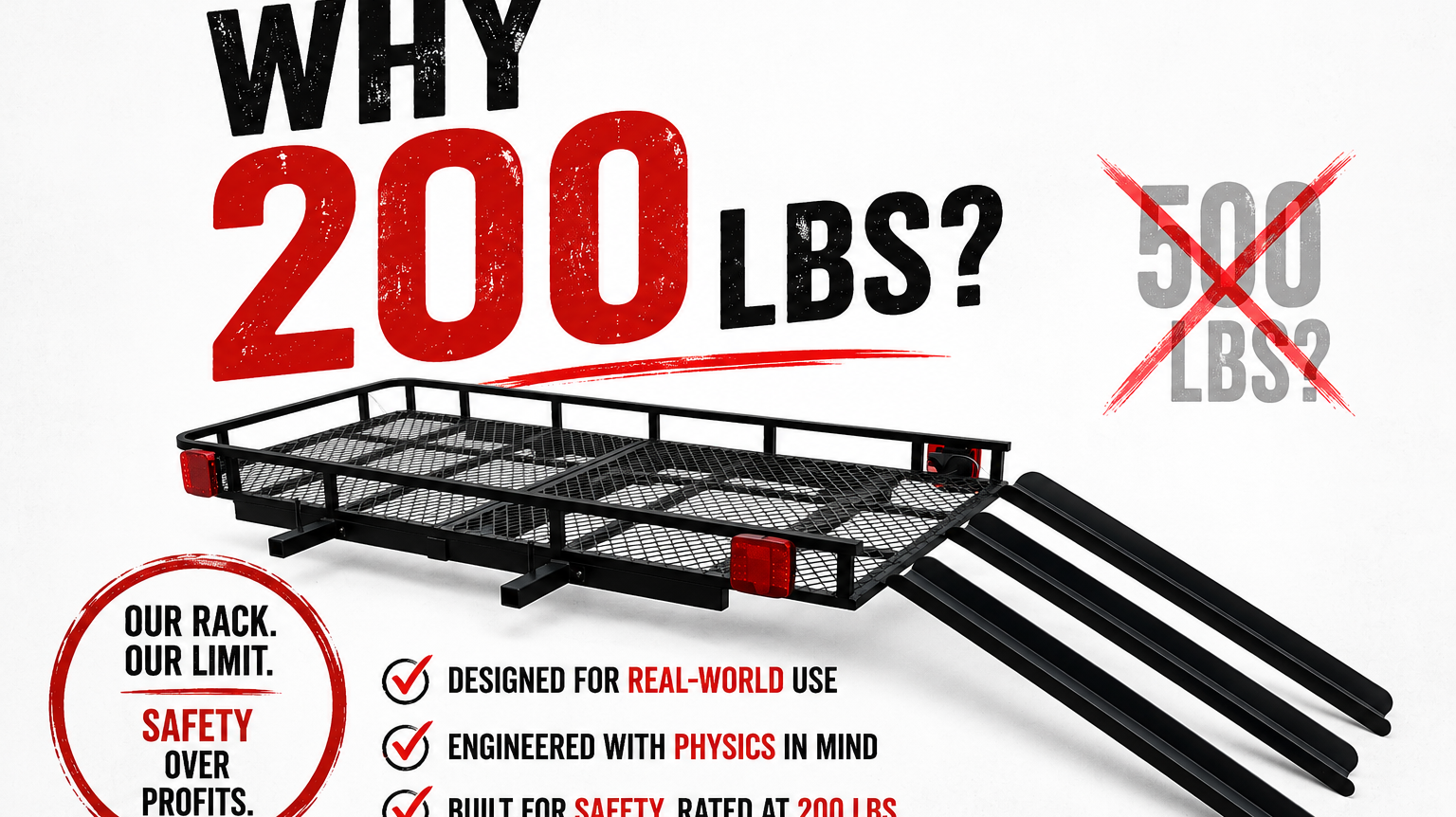
Every carrier has limits.
The carrier, hitch, and vehicle must all be appropriate for the load being transported.
You need to consider:
-
Carrier capacity
-
Loaded carrier weight
-
Receiver hitch requirements
-
Vehicle limitations
-
Cargo dimensions
-
Proper load distribution
-
Appropriate securement
-
Ground clearance
-
Lights and license plate visibility
Always follow the applicable vehicle, hitch, and carrier specifications.
A versatile carrier is still a rated piece of transportation equipment.
Securement Changes With the Load
An e-trike and a cooler obviously aren't secured the same way.
Whenever you change what you're carrying, you also need to consider how that load will be restrained.
Cargo should not be able to slide, bounce, tip, or leave the platform during travel.
Use appropriate securement methods for the particular load and follow the carrier manufacturer's instructions.
The platform provides the usable space.
It's still the owner's responsibility to make sure whatever occupies that space is appropriate and properly secured.
What Should You Look for in a Multi-Use E-Trike Carrier?
If versatility is important to you, look beyond whether the carrier simply fits your e-trike.
Consider the platform itself.
How much usable surface area does it provide?
Is the floor open enough for different cargo configurations?
Are there useful locations for securing loads?
How easy is it to load?
Can the carrier accommodate the dimensions and weight of your particular e-trike?
And when the trike isn't there, does the design still provide a genuinely useful cargo area?
Those questions help distinguish a true multi-use platform from a carrier that is useful only for bicycles or trikes.
Why Hitch-Rack Pro Uses a Platform Design
At Hitch-Rack Pro, we wanted to solve the e-trike transportation problem without creating a product that had to sit unused whenever the e-trike stayed home.
That's why the platform itself is an important part of the design.
When it's time to ride, the carrier provides the space needed to transport an e-trike or compatible e-bike configuration.
When it's time for another type of trip, the platform can serve as useful cargo space for appropriate loads.
One hitch carrier. Multiple potential uses.
For many owners, that makes more sense than buying and storing several different hitch-mounted products.
Buy a Carrier for the Trips You Haven't Taken Yet
When you're shopping for an e-trike rack, it's natural to think about your trike.
But think about everything else you do with your vehicle too.
Camping.
Traveling.
Outdoor recreation.
Projects around the house.
Family vacations.
Weekend adventures.
If you're going to put a substantial piece of equipment into your receiver hitch, there's real value in having equipment that can do more than one job.
A dedicated e-trike rack carries your trike.
A well-designed platform carrier can carry your trike and remain useful after the trike comes off.
That's the advantage of a multi-use rack.
Frequently Asked Questions
What is the difference between an e-trike rack and a platform rack?
A dedicated e-trike rack is typically designed around the trike's three wheels using individual trays or supports. A platform carrier provides a larger continuous cargo surface that can accommodate an e-trike while potentially serving other cargo-carrying purposes when the trike isn't being transported.
Can a platform rack carry cargo instead of an e-trike?
A platform-style carrier may be used for compatible cargo if the carrier manufacturer permits it. The cargo must remain within applicable weight and dimensional limits and be properly secured.
What can you carry on a hitch platform?
Depending on the carrier's specifications, suitable cargo could include coolers, storage totes, camping equipment, luggage, tools, and other appropriately sized and secured items.
Is a platform carrier better than a dedicated e-trike rack?
It depends on your priorities. A dedicated rack may be ideal if transporting an e-trike is its only intended job. A platform carrier may provide greater value to someone who also wants additional cargo-carrying capability.
Can I carry an e-trike and cargo at the same time?
That depends on the dimensions and capacity of the specific carrier, the e-trike, the cargo, the hitch, and the vehicle. Never exceed applicable ratings or obstruct required lights, plates, or other safety equipment.
Why choose a multi-use hitch carrier?
A multi-use carrier can potentially replace the need for separate equipment for different trips, giving the owner a useful cargo platform even when the e-trike isn't being transported.