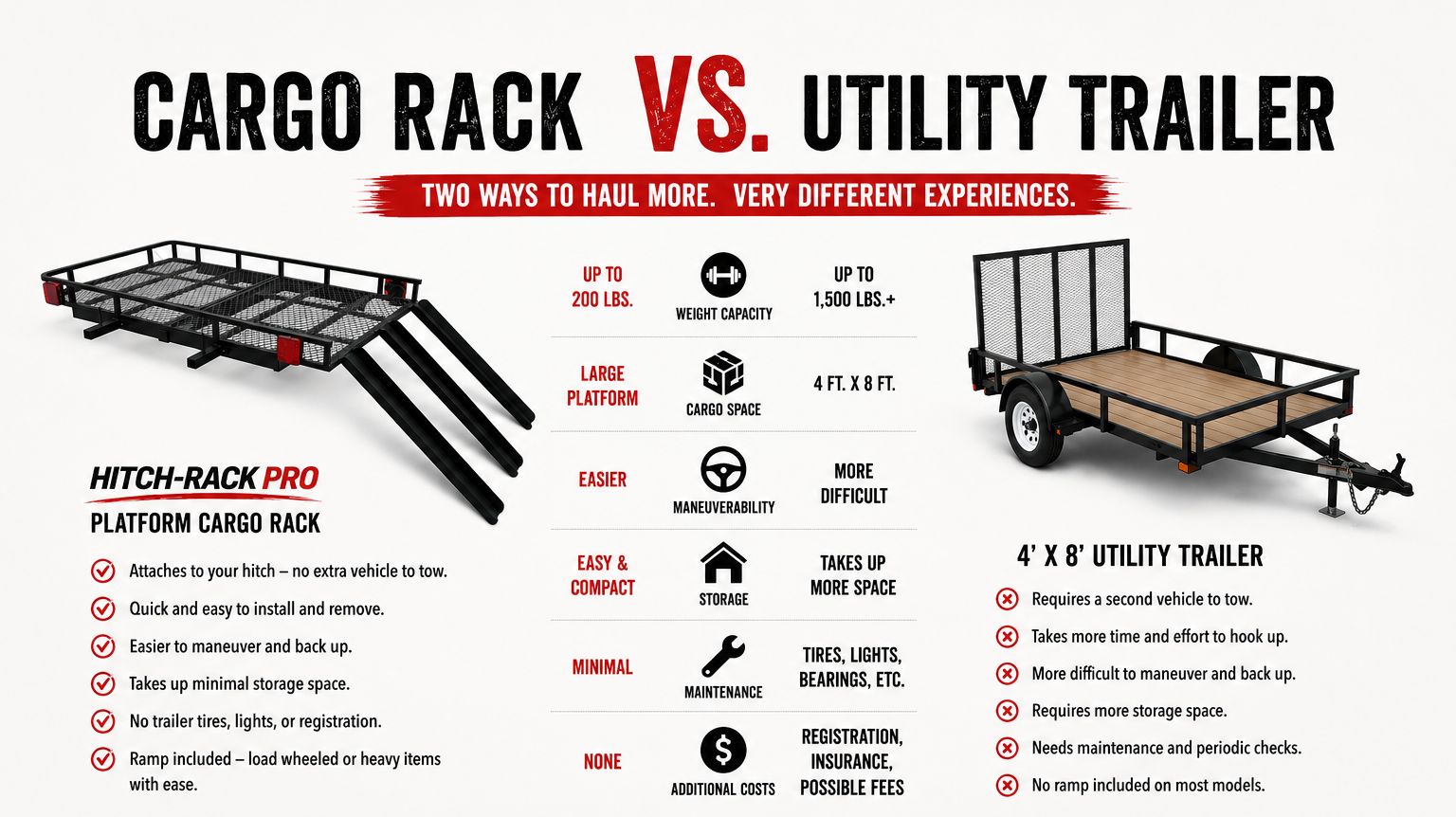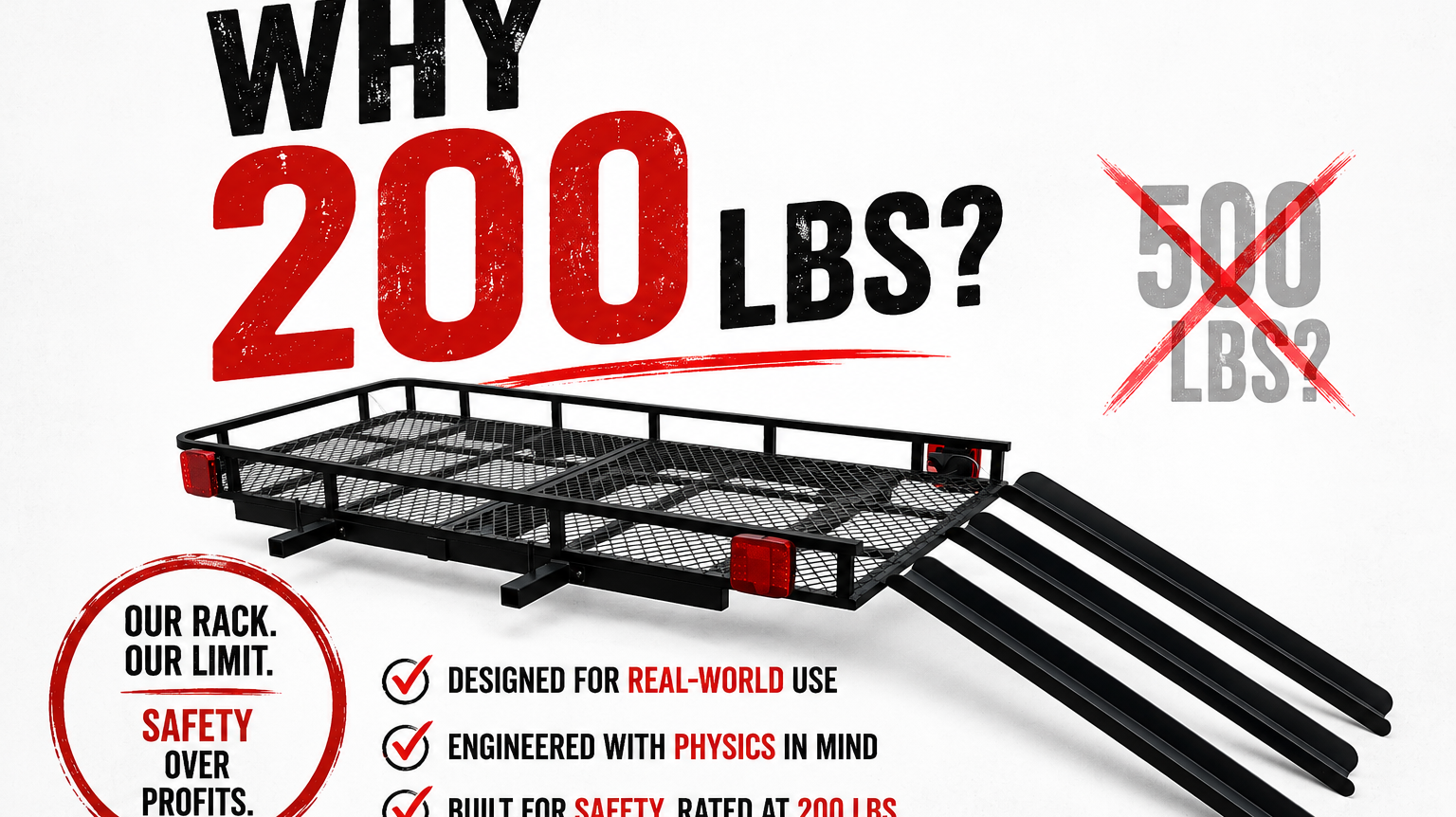

E-Trike Rack Ramps: Full-Width Folding Ramp vs. Detachable Ramps
When shopping for an e-trike rack, it's easy to focus on weight capacity, hitch size, and whether your trike will fit.
But there's another feature you'll use every single time you transport your e-trike:
The loading ramp.
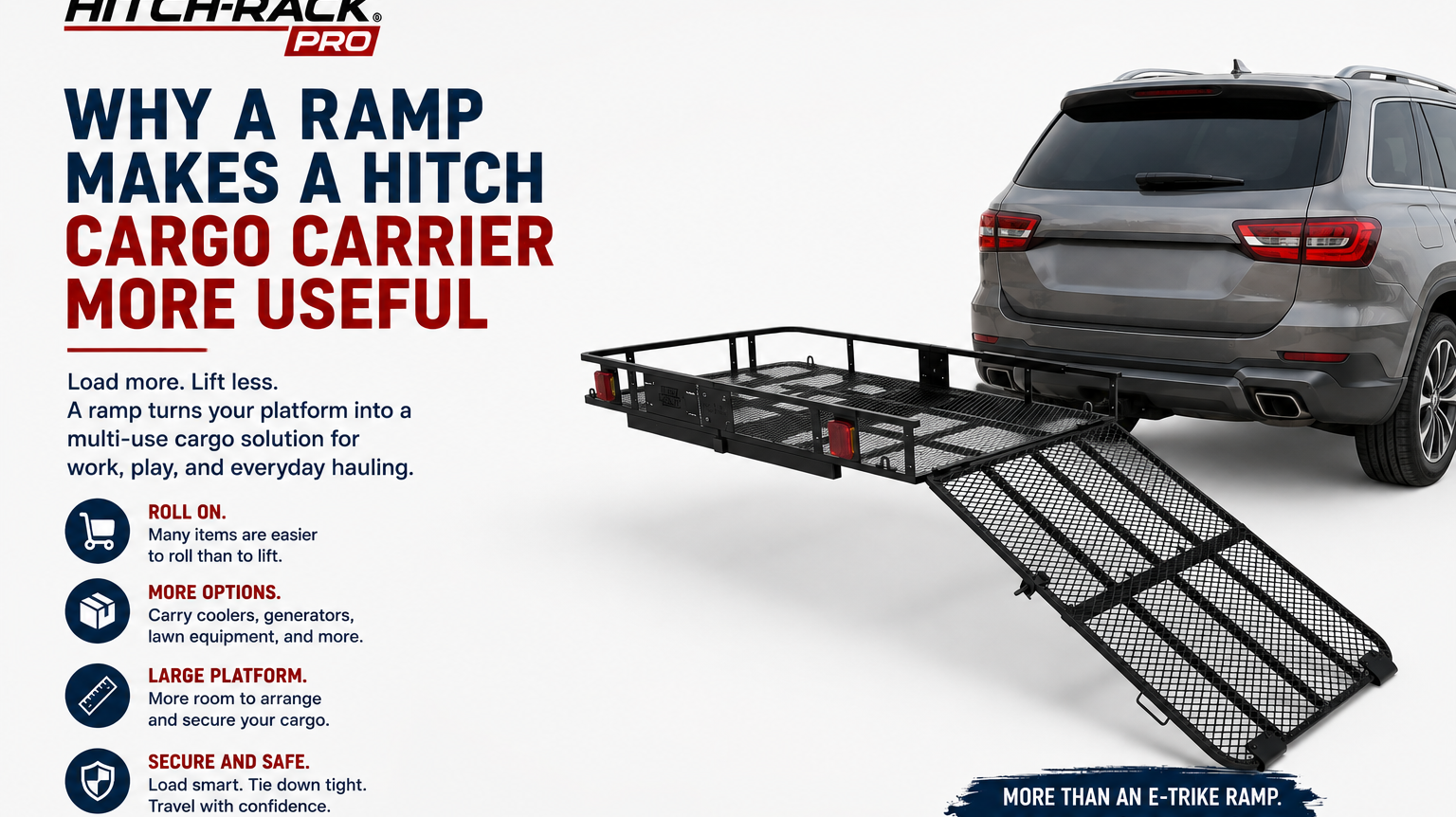
Electric trikes are heavy, wide, and awkward to lift. A good ramp lets you roll the trike onto the carrier instead of trying to lift it into place.
Not all e-trike rack ramps work the same way, though.
Two common approaches are a full-width folding ramp and a system using three detachable wheel ramps.
Both can get an e-trike from the ground onto the carrier, but there are important differences in storage, weight, loading, and—perhaps most importantly—how well the ramps help keep the tires where they belong.
Let's compare them.
Why the Ramp Matters So Much on an E-Trike Rack
Loading a bicycle onto a carrier is relatively straightforward because you're controlling two wheels in a straight line.
An e-trike is different.
You're moving three wheels up the ramps at the same time.
That means all three wheels need to stay aligned as the trike travels from the ground onto the carrier.
If one wheel moves toward the edge of a narrow ramp, loading can quickly become more difficult.
And because e-trikes can be heavy, correcting the trike once a tire starts moving off the side of a ramp isn't always easy.
That's why ramp design deserves more attention than it sometimes receives.
Option 1: Full-Width Folding E-Trike Ramps
Some e-trike carriers use a large ramp spanning most or all of the width needed for the trike.
The ramp typically folds when it isn't being used.
The obvious advantage is that you're essentially creating one large loading surface rather than lining up three separate ramps.
Position the trike, deploy the ramp, and roll the trike onto the carrier.
That simplicity can be appealing.
Advantages of a Full-Width Ramp
A full-width ramp can provide a generous loading surface.
Because the space between the wheel paths is also covered, precise wheel alignment may be less critical than with three completely separate ramps.
There's also only one ramp assembly to deploy rather than three individual pieces.
For some users, that makes setup straightforward.
The Tradeoffs of a Full-Width Folding Ramp
The same thing that makes a full-width ramp convenient can also be its disadvantage:
It's big.
A ramp wide enough to accommodate an e-trike requires considerably more material than three individual wheel ramps.
That can mean additional:
- Weight
- Bulk
- Storage space
- Hardware
- Moving or folding components
Depending on the design, the ramp may remain attached to the carrier and fold into a storage position.
That means the ramp assembly travels with the rack even though it's only needed for a few minutes during loading and unloading.
For some owners, that's perfectly acceptable.
Others may prefer a system where the ramps can be completely removed after the trike is loaded.
Option 2: Three Detachable E-Trike Ramps
Another approach is to use three separate ramps—one for each wheel of the e-trike.
Each ramp attaches to the carrier for loading and unloading and can then be removed.
Instead of carrying a large full-width ramp assembly, you're carrying only the ramp surfaces the three tires actually need.
This can make the ramp system more compact and easier to handle.
But there's an important detail that can make a major difference:
The shape of the individual ramps.
The Problem With Low-Profile E-Trike Ramps
Many detachable loading ramps have a relatively flat or low-profile design.
At first glance, that seems reasonable. A tire only needs a surface to roll on.
The problem appears when the tire doesn't stay perfectly centered.
While you're loading an e-trike, you're trying to control three wheels simultaneously.
If one wheel begins drifting toward the edge of a low-profile ramp, there may be very little preventing it from rolling off.
The same thing can happen during unloading.
Once a tire slips off the side, you're suddenly dealing with a heavy trike that is no longer sitting evenly on all three ramps.
That's something we'd rather help prevent in the first place.
Why Ramp Side Height Matters
Think about the difference between a flat board and a channel.
A flat board gives the tire a surface to roll across.
A channel also provides side guidance.
That's the principle behind the detachable ramps used with Hitch-Rack Pro carriers.
Our detachable ramps are designed with 2-inch-high sides.
Those raised sides help keep the tires within the ramp channel while you're loading and unloading.
Instead of relying entirely on the person loading the trike to keep all three tires perfectly centered, the ramp itself provides additional guidance.
That can be especially helpful when you're controlling a heavy e-trike by yourself.
Why We Chose 2-Inch-High Sides
We didn't want the ramp to simply provide a path from the ground to the carrier.
We wanted it to help guide the tire along that path.
The 2-inch-high sides create a more defined wheel channel.
If a tire begins moving toward one side while the trike is being rolled up or down the ramp, the raised edge helps discourage the tire from simply rolling off.
That doesn't mean you can stop paying attention while loading.
You should always keep the trike controlled and watch the wheel positions.
But the ramp design provides another layer of assistance rather than leaving the tire on a nearly flat surface with little margin for error.
Three Ramps Also Allow Individual Wheel Positioning
Separate ramps have another useful characteristic: each wheel gets its own loading path.
That allows the ramps to be positioned for the wheel locations required by the carrier and trike.
Once positioned, the three ramps create individual channels leading each wheel onto the platform.
After loading, the ramps can be detached.
You aren't permanently carrying a large loading surface behind the vehicle simply because you needed it for a few minutes.
Full-Width Ramp vs. Three Detachable Ramps
So which approach is better?
It depends on what matters most to you.
A Full-Width Folding Ramp May Appeal to You If:
You like having one large loading surface and don't want to position multiple ramps.
A full-width ramp can also reduce the need to precisely align each wheel with an individual ramp before loading.
The tradeoff is the additional size and bulk associated with the larger ramp assembly.
Three Detachable Ramps May Appeal to You If:
You prefer a more compact loading system that can be removed when it isn't needed.
Individual ramps only provide loading surfaces where the tires actually travel, which can reduce unnecessary material and bulk.
But when comparing detachable ramp systems, pay attention to the sides of the ramps.
A narrow ramp with very little edge protection may leave less room for error if a tire begins moving sideways.
What Should You Look for in an E-Trike Loading Ramp?
When comparing e-trike carriers, don't simply ask whether a ramp is included.
Take a closer look at how that ramp actually works.
Frequently Asked Questions
What type of ramp is best for an e-trike rack?
Both full-width and individual ramp systems can work. Consider loading surface, ramp weight and bulk, storage, attachment method, ramp angle, tire compatibility, and how well the ramp helps guide the tires during loading.
Why do e-trike ramps need raised sides?
Raised sides can help guide the tire and reduce the chance of it simply rolling off the edge if the wheel moves sideways during loading or unloading.
How high are the sides on Hitch-Rack Pro ramps?
Hitch-Rack Pro detachable ramps are designed with 2-inch-high sides to help keep the e-trike's tires within the ramp channels while loading and unloading.
Is a full-width e-trike ramp easier to use?
A full-width ramp provides one large loading surface and eliminates the need to position three individual ramps. However, the larger ramp can also add bulk and weight. Which design is preferable depends on the user's priorities.
Why use three ramps for an e-trike?
An e-trike has three wheels, so individual ramps provide a dedicated loading path for each wheel. Once the trike is loaded, detachable ramps can be removed and stored.
Can an e-trike tire fall off a loading ramp?
A tire can move toward or over the edge of a ramp if it isn't kept properly aligned. Low-profile ramps may provide relatively little side guidance, which is why ramp profile and side height are worth considering when comparing carriers.