
How Do You Transport an E-Trike Without a Trailer?
One of the great things about owning an electric trike is the freedom to explore farther from home. Trails, campgrounds, beaches, parks, vacation destinations, and riding events suddenly become much more accessible.
But first, you have to get your e-trike there.
Because electric trikes are larger and heavier than conventional bicycles, transporting one isn't always as simple as putting it on a standard bike rack.
Many owners assume they need a utility trailer.
Fortunately, that's not necessarily true.
A properly matched hitch-mounted e-trike carrier can allow you to transport an electric trike without towing a trailer.
Let's look at the available options and what you should consider before hitting the road.
Why Is an E-Trike Harder to Transport?
An e-trike creates several transportation challenges that don't exist with a conventional bicycle.
First is the three-wheel configuration. Two of the wheels sit side-by-side, making the trike considerably wider than a bicycle.
Then there's weight. The frame, electric motor, battery, larger seat, baskets, accessories, and third wheel all contribute to the total.
Finally, there's the physical size of the trike.
These factors can make conventional bike racks, roof racks, and simply lifting the trike into a vehicle impractical.
That's why choosing a transportation method designed around the actual dimensions of an e-trike is important.
Option 1: A Hitch-Mounted E-Trike Carrier
For many e-trike owners, a purpose-built hitch carrier is one of the most practical alternatives to towing a trailer.
The carrier attaches directly to a compatible receiver hitch and carries the trike behind the vehicle.
For a carrier designed around e-trikes, the trike typically sits across the rear of the vehicle, facing toward one side rather than facing forward.
This arrangement takes advantage of the width behind the vehicle and allows the carrier to support the trike's three-wheel configuration.
Why Use a Hitch Carrier?
The biggest advantage is convenience.
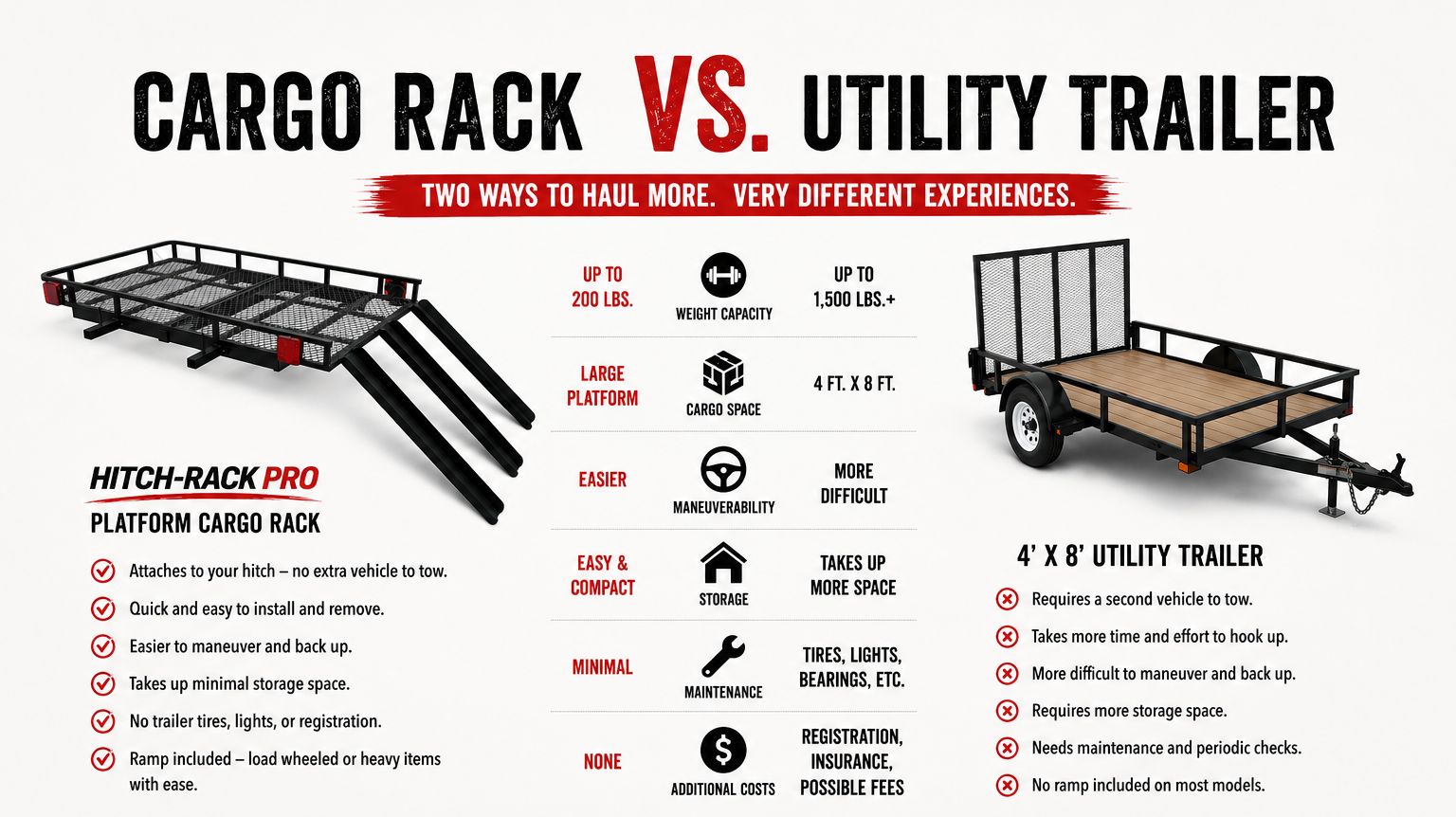
Unlike a trailer, a hitch-mounted carrier doesn't have its own axle, wheels, tires, registration requirements in some jurisdictions, or separate storage footprint.
You also don't have to back up a trailer every time you pull into a campsite or parking area.
Once you arrive, unload the trike and you're ready to ride.
For people who travel frequently with an e-trike, simplifying the transportation process can make a significant difference.
Option 2: Transport the E-Trike Inside Your Vehicle
Depending on your vehicle and the size of your trike, carrying it inside may be possible.
A large cargo van, pickup with an enclosed bed, or certain SUVs may provide enough room.
But you'll need to consider more than whether the trike technically fits.
Ask yourself:
-
Can you load it without excessive lifting?
-
Can you secure it properly?
-
Does it block visibility?
-
Will you still have room for passengers and luggage?
-
Could the trike move during hard braking or a sudden maneuver?
-
Can you unload it easily at your destination?
Removing baskets, seats, or other accessories may reduce the space required, depending on the trike.
For occasional transportation, carrying an e-trike inside a sufficiently large vehicle may work.
For frequent trips, however, repeatedly loading a heavy trike into the cargo area can become inconvenient.
Option 3: Carry the E-Trike in a Pickup Truck
A pickup bed provides another option.
Depending on the dimensions of the trike and truck bed, you may be able to carry the e-trike in the bed and secure it appropriately.
Again, loading height matters.
Getting a heavy electric trike into a pickup bed may require a suitable ramp system.
You'll also need appropriate tie-down points and a securement method that prevents the trike from shifting while driving.
Bed length, bed width, wheel wells, tonneau covers, toolboxes, and other equipment can affect whether the trike fits.
A pickup can be a good solution, but owners who need their truck bed for camping equipment, luggage, tools, or other cargo may prefer to keep the trike outside the bed.
Why Not Just Use a Small Utility Trailer?
You certainly can.
A utility trailer can provide plenty of room and may be an appropriate choice if you're transporting several large bikes, multiple trikes, or other equipment at the same time.
But trailers come with tradeoffs.
You'll need somewhere to store the trailer when it isn't being used.
You'll also need to hitch and unhitch it, maintain its tires and lights, and become comfortable maneuvering and backing with a trailer attached.
Depending on where you live and travel, additional registration, insurance, toll, parking, or regulatory considerations may apply.
For someone who already owns and regularly uses a trailer, none of that may be a major concern.
But buying a trailer solely to transport one e-trike can be more equipment than some owners want to deal with.
Why a Regular Bike Rack Usually Isn't the Answer
You may already have a hitch-mounted bicycle rack sitting in your garage.
Unfortunately, that doesn't necessarily mean it can carry your e-trike.
Most standard racks are designed around two-wheel bicycles. Their trays, supports, spacing, and attachment systems assume two wheels arranged in a straight line.
An e-trike has a completely different footprint.
Even a heavy-duty rack designed for electric bicycles may not be suitable for an electric trike.
Weight capacity alone doesn't determine compatibility.
The carrier also needs to accommodate the trike's width, wheel configuration, wheelbase, tires, and securement requirements.
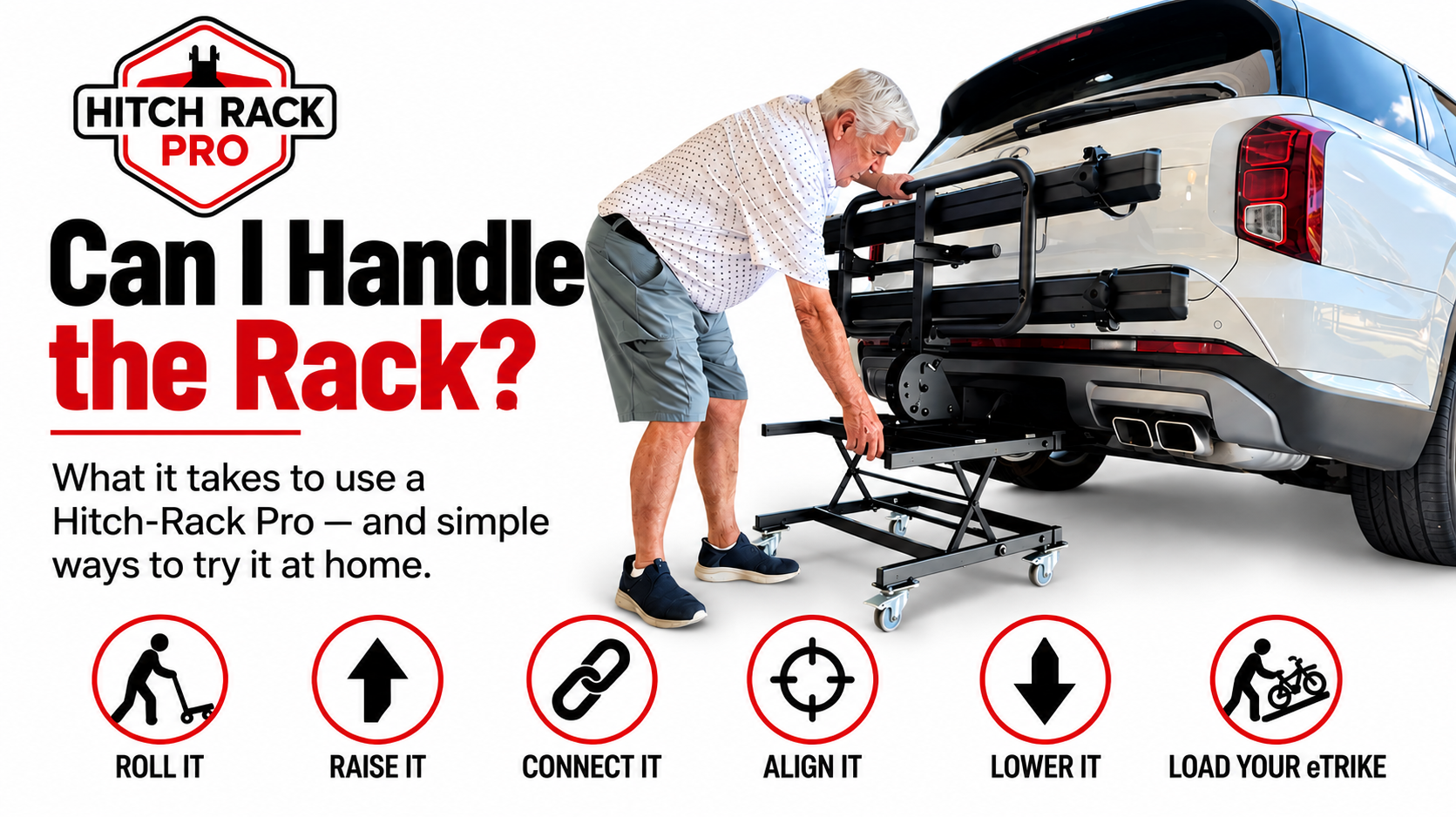
Loading an E-Trike Without Heavy Lifting
Transporting the trike is only half the problem.
You still have to get it onto the carrier.
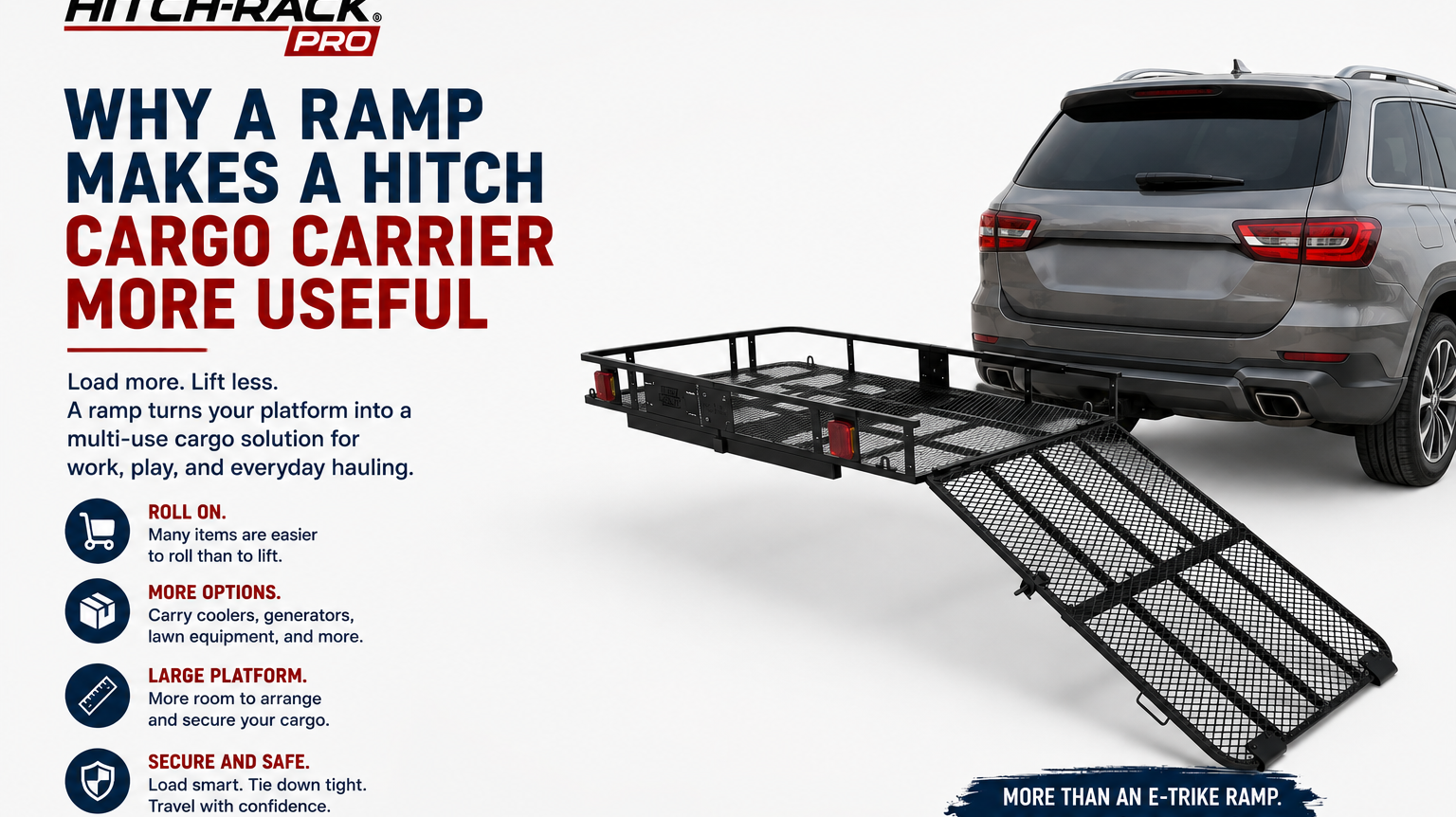
That's where a loading ramp becomes particularly useful.
A ramp allows the trike to be rolled onto the platform rather than lifted onto it.
For a heavy e-trike, reducing the amount of lifting can make loading much easier—especially when traveling alone.
When evaluating a carrier, consider the entire loading process:
Where does the ramp attach?
How steep is the loading angle?
How does the trike transition from the ramp onto the carrier?
Can you control the trike safely while loading?
How easily can the ramp be stored after loading?
A good transportation system shouldn't just hold the trike once it's loaded. It should make getting the trike onto and off the carrier practical as well.
Measure Your E-Trike Before Choosing a Carrier
Not all e-trikes are the same size.
Before choosing any transportation system, measure your actual trike.
Important measurements include:
-
Total weight
-
Overall width
-
Overall length
-
Wheelbase
-
Tire width
-
Wheel diameter
You should also consider accessories such as baskets, mirrors, fenders, seats, and cargo boxes.
Measure the trike in the configuration you expect to transport.
A few minutes with a tape measure can prevent a frustrating compatibility problem later.
Don't Forget the Weight of the Carrier
When evaluating whether your vehicle can handle an e-trike carrier, don't look only at the weight of the trike.
The carrier itself has weight too.
The vehicle and hitch must accommodate the complete system as applicable:
carrier weight + e-trike weight + additional equipment carried on the rack
Check the specifications for your vehicle, receiver hitch, and carrier.
The allowable capacity of the system is determined by its applicable limits—not simply by the size of the receiver opening.
Is a Hitch Carrier Easier Than a Trailer?
For transporting one e-trike—or certain combinations of e-bikes and e-trikes—a hitch-mounted carrier can be considerably simpler than towing a trailer.
There is no trailer to store, maneuver, or back into a parking space.
You attach the carrier to the vehicle, load the trike, secure it according to the manufacturer's instructions, and travel.
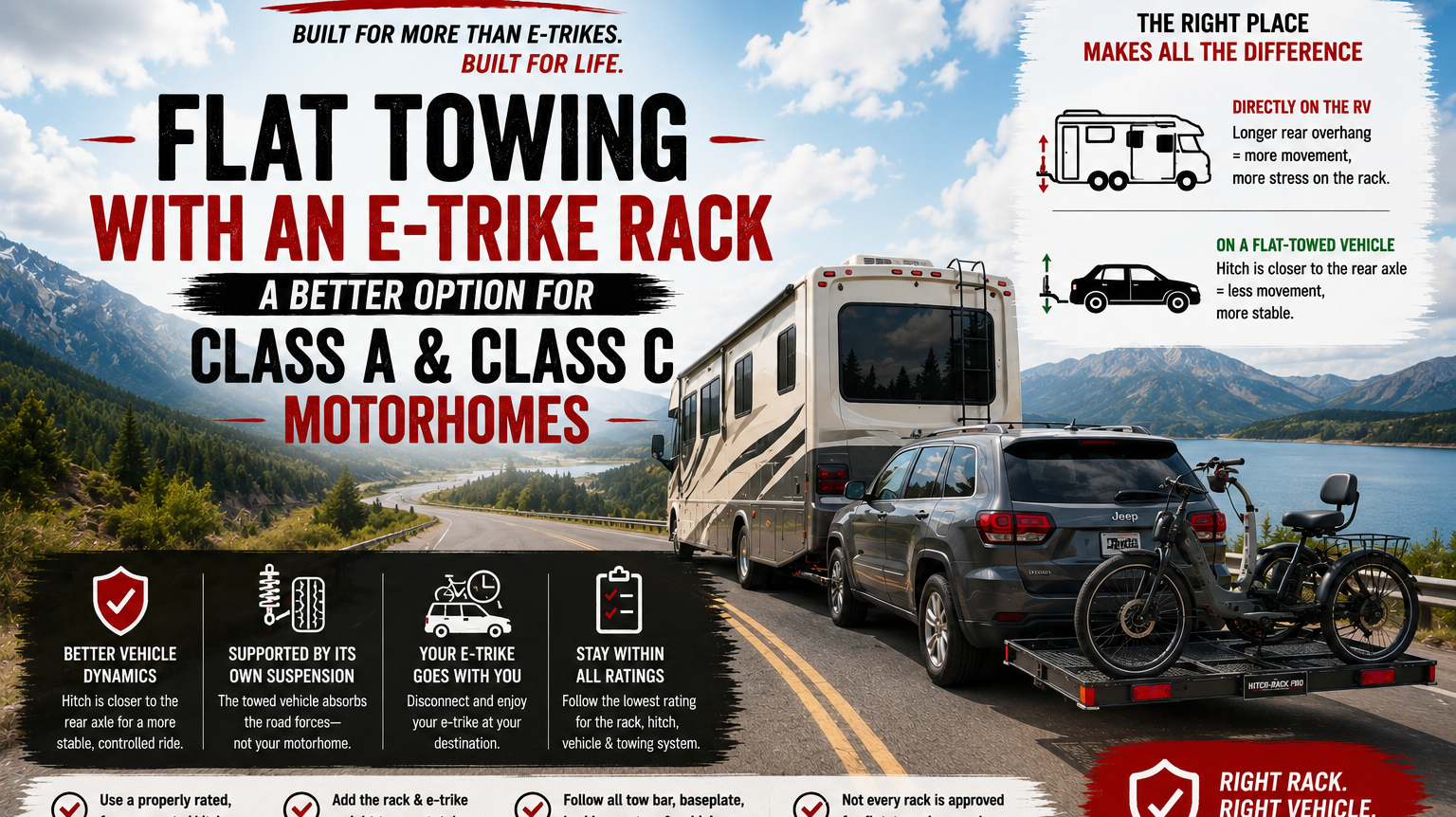
That simplicity is particularly valuable for RV travelers, campers, and riders who regularly drive to different riding locations.
A trailer still has advantages when carrying larger quantities of equipment.
The better choice depends on what you're transporting and how you travel.
What About RVs?
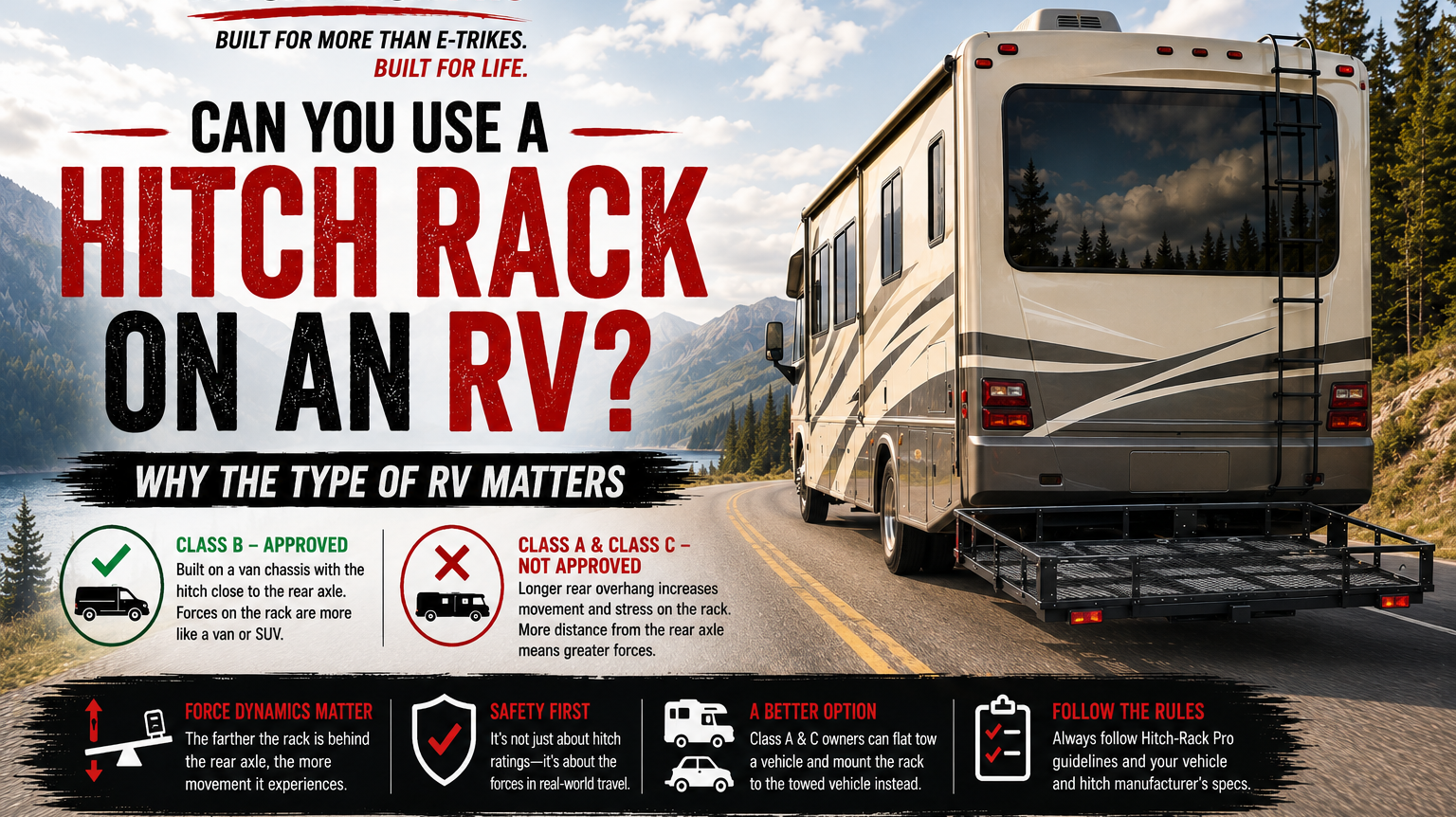
RV owners should pay particularly close attention to carrier compatibility.
The forces experienced by equipment mounted behind an RV can differ from those behind a typical passenger vehicle, particularly when the mounting point is farther from the rear axle.
A carrier that can be used on an SUV or pickup should not automatically be assumed to be approved for RV use.
Check both the carrier manufacturer's requirements and the specifications of your RV and hitch before using any carrier in that application.
Choosing the Right Way to Transport Your E-Trike
There isn't one solution that's perfect for every owner.
Carrying the trike inside a large vehicle may work well if you only transport it occasionally.
A pickup bed may be convenient if you already own a truck and don't need the bed for other cargo.
A utility trailer may make sense when you're transporting multiple large cycles or additional equipment.
But if your goal is to transport an e-trike without towing a trailer, a purpose-built hitch-mounted carrier deserves serious consideration.
It keeps the trike outside the passenger and cargo areas, eliminates the need for a separate trailer, and can provide a much lower loading height than many other options.
Take Your E-Trike Farther
Your e-trike shouldn't limit you to rides that begin at your front door.
The right transportation setup can open up entirely new places to explore.
At Hitch-Rack Pro, our carriers are designed around the unique transportation challenges presented by e-trikes and e-bikes—including their weight, dimensions, and loading requirements.
The goal isn't simply to carry your trike.
It's to make taking it with you practical enough that you'll actually do it.
Load up.
Hit the road.
And enjoy the ride when you get there.
Frequently Asked Questions
What is the easiest way to transport an e-trike?
For many owners, a compatible hitch-mounted e-trike carrier with a loading ramp can be one of the easiest solutions because the trike can be carried outside the vehicle and loaded relatively close to ground level.
Do I need a trailer to transport an electric trike?
Not necessarily. Depending on your vehicle, hitch, trike dimensions, and weight, a purpose-built hitch carrier may allow you to transport an e-trike without towing a trailer.
Can I transport an e-trike in an SUV?
Possibly. It depends on the dimensions of both the SUV's cargo area and the trike. You also need a safe way to load and secure the trike. A hitch-mounted carrier can preserve interior cargo and passenger space.
Can I carry an e-trike in a pickup bed?
Depending on the size of the truck bed and trike, yes. You'll need to consider loading, securement, available bed space, and interference from wheel wells or other equipment.
Can I use my regular bike rack instead?
Most standard bike racks are designed for two-wheel bicycles and shouldn't be assumed to accommodate an e-trike. Check the manufacturer's specifications for weight, dimensions, wheel configuration, and approved uses.
How does an e-trike sit on a hitch carrier?
On a carrier designed around this configuration, the e-trike can sit across the rear of the vehicle, with the trike facing toward one side rather than facing forward. Always follow the loading orientation specified by the carrier manufacturer.