
If you've recently purchased an electric trike, you may already own a bike rack—or you may have noticed plenty of inexpensive racks designed for traditional bicycles and e-bikes.
That leads to an obvious question:
Can you put an e-trike on a regular bike rack?
In most cases, a standard bike rack isn't designed to carry an e-trike.
The problem isn't simply that an e-trike has an extra wheel. Electric trikes can be considerably heavier and wider than conventional bicycles, and their wheel spacing and frame geometry are very different.
Before trying to adapt a standard bike rack, it's important to understand those differences.
Why Regular Bike Racks Usually Don't Work for E-Trikes
Most conventional bike racks are designed around the basic shape of a two-wheel bicycle.
Whether it's a hanging rack or platform rack, the manufacturer generally assumes that the bike will have two wheels positioned in a relatively narrow, straight line.
An e-trike changes that completely.
With two wheels positioned side-by-side at one end of the trike, the carrier needs enough width and the correct support points to hold all three wheels securely.
Then there's the weight.
The electric motor, battery, larger frame, three-wheel design, baskets, and other components can make an e-trike much heavier than the bicycles a standard rack was designed to carry.
Trying to make the trike "fit" doesn't mean the rack is capable of safely supporting it.
Weight Capacity Is Critical
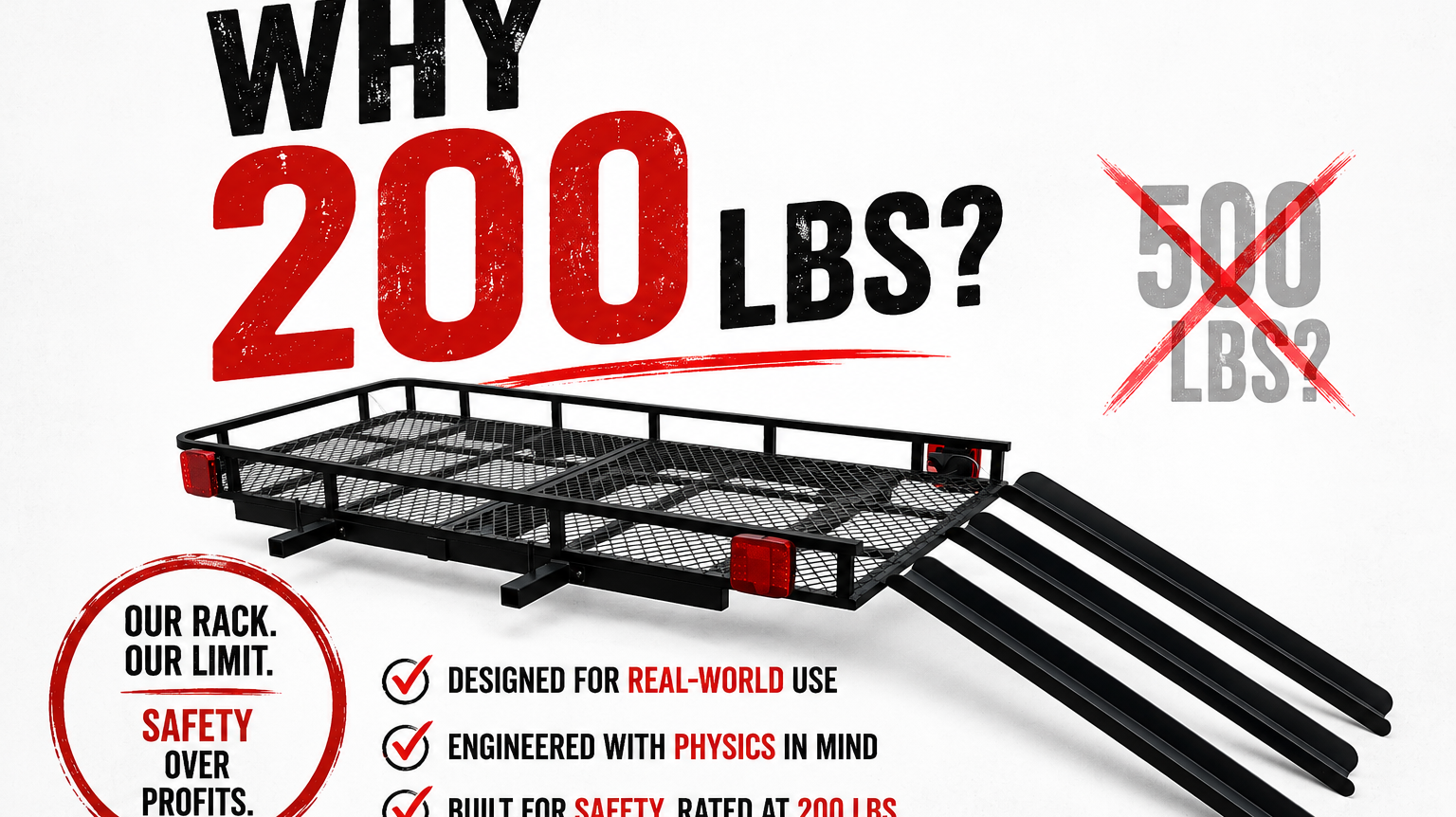
One of the first specifications to check on any bike rack is its rated weight capacity.
Don't assume that a rack designed for multiple bicycles can carry one heavy e-trike.
For example, if a rack is rated for two bikes, that doesn't necessarily mean its entire capacity can be concentrated into a single position. Manufacturers may specify both a total capacity and a maximum weight per bike.
You also need to consider the complete system:
E-trike → carrier → receiver hitch → vehicle
The safe capacity of the system is limited by its weakest component.
That means a heavy-duty carrier doesn't automatically make a vehicle capable of carrying a heavy load on the hitch.
Always verify the ratings provided by the carrier, hitch, and vehicle manufacturers.
An E-Trike Is Much Wider Than a Bicycle
Width is one of the most obvious differences between an e-trike and a traditional bike.
A standard platform bike rack generally uses two relatively narrow wheel trays positioned behind the vehicle.
An e-trike needs support for three wheels, including two wheels that may be positioned far apart.
A purpose-built e-trike carrier needs to accommodate that width without forcing the trike into a position the carrier wasn't designed to support.
This is why knowing the overall width of your trike is important before choosing a carrier.
Don't rely only on the manufacturer's model name. Measure the actual trike you're planning to transport.
Wheelbase and Tire Size Matter Too
Width isn't the only measurement that matters.
Before buying an e-trike carrier, you should also know:
-
Overall trike width
-
Wheelbase
-
Tire width
-
Wheel diameter
-
Total weight
-
Overall length
Accessories can matter as well.
Baskets, fenders, mirrors, seats, cargo boxes, and other equipment may affect how the trike fits or where it can be secured.
A carrier needs to accommodate the actual configuration you're transporting, not simply the basic specifications of the original trike.
What About a Heavy-Duty E-Bike Rack?
This is another common question.
Some hitch-mounted e-bike racks are designed to carry much heavier bicycles than conventional bike racks.
That's useful—but weight capacity alone doesn't make an e-bike rack suitable for an e-trike.
The rack still has to accommodate:
-
Three wheels
-
The trike's width
-
Its wheel spacing
-
Its wheelbase
-
Its tire dimensions
-
Appropriate securement points
A rack capable of carrying a 70- or 80-pound bicycle isn't automatically capable of carrying an e-trike of similar weight.
Capacity and compatibility are two different things.
Can You Modify a Regular Bike Rack to Carry an E-Trike?
It may be tempting to modify an existing rack by adding a tray, platform, brackets, straps, or other components.
That's not something to do casually.
When you modify a carrier, you may change how loads are distributed through the rack and into the receiver hitch.
You're also using the carrier outside the configuration in which it was designed and rated.
At highway speeds, the forces acting on a bike or trike aren't limited to its static weight. Bumps, braking, turns, road vibration, and movement can place additional forces on the carrier and its attachment points.
For something as large and valuable as an electric trike, purpose-built equipment is generally the better approach.
Why Hitch-Mounted Platforms Make Sense for E-Trikes
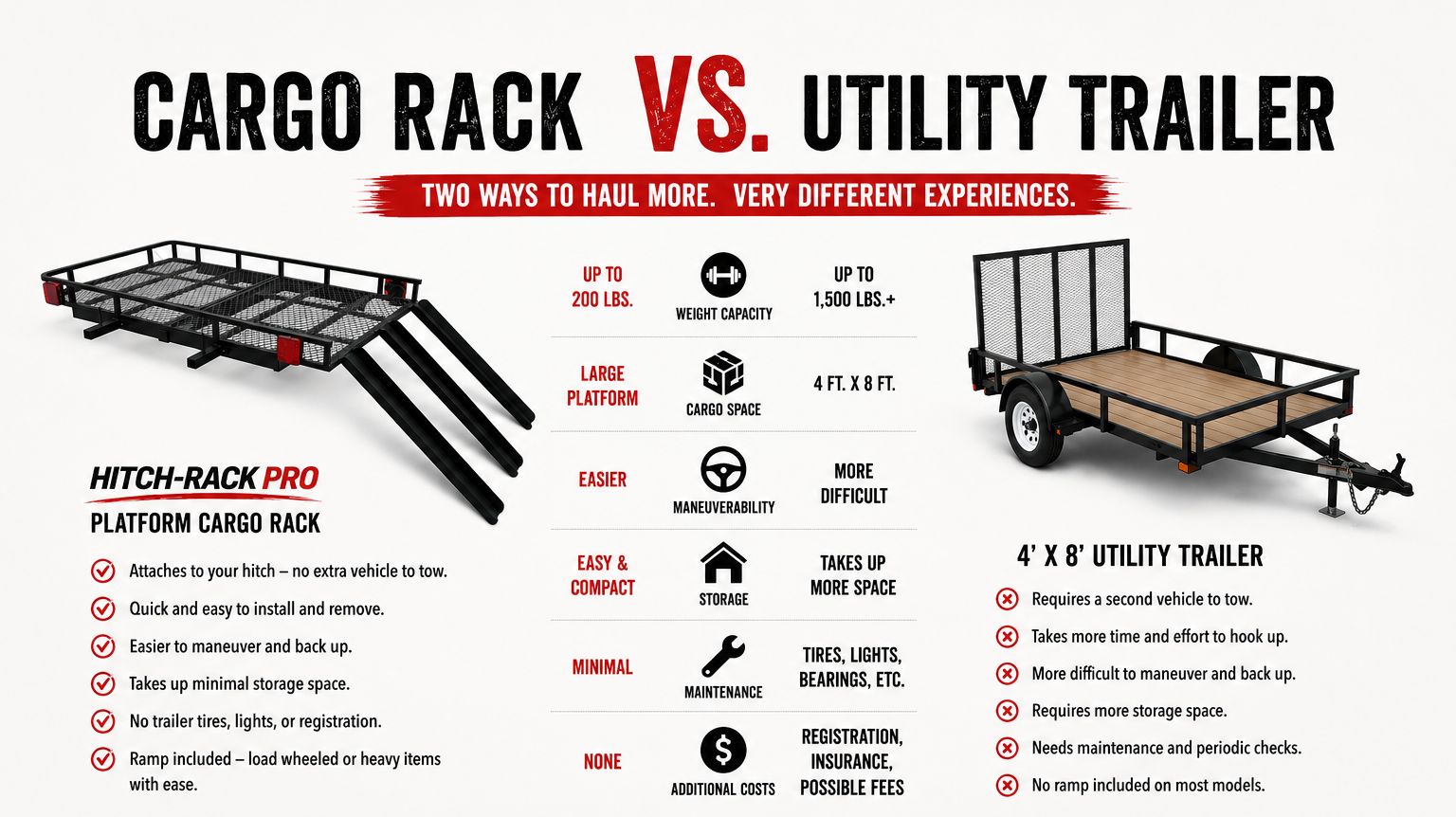
A hitch-mounted platform offers several advantages for transporting an e-trike.
First, it keeps the trike relatively close to ground level.
That's important because lifting an e-trike onto a traditional rack—or especially onto the roof of a vehicle—can be difficult and impractical.
A platform can also provide support underneath the trike rather than depending entirely on its frame.
Most importantly, a carrier specifically designed for e-trikes can account for the three-wheel layout from the beginning.
Instead of adapting a two-bike solution to a three-wheel problem, you're using equipment intended for the job.
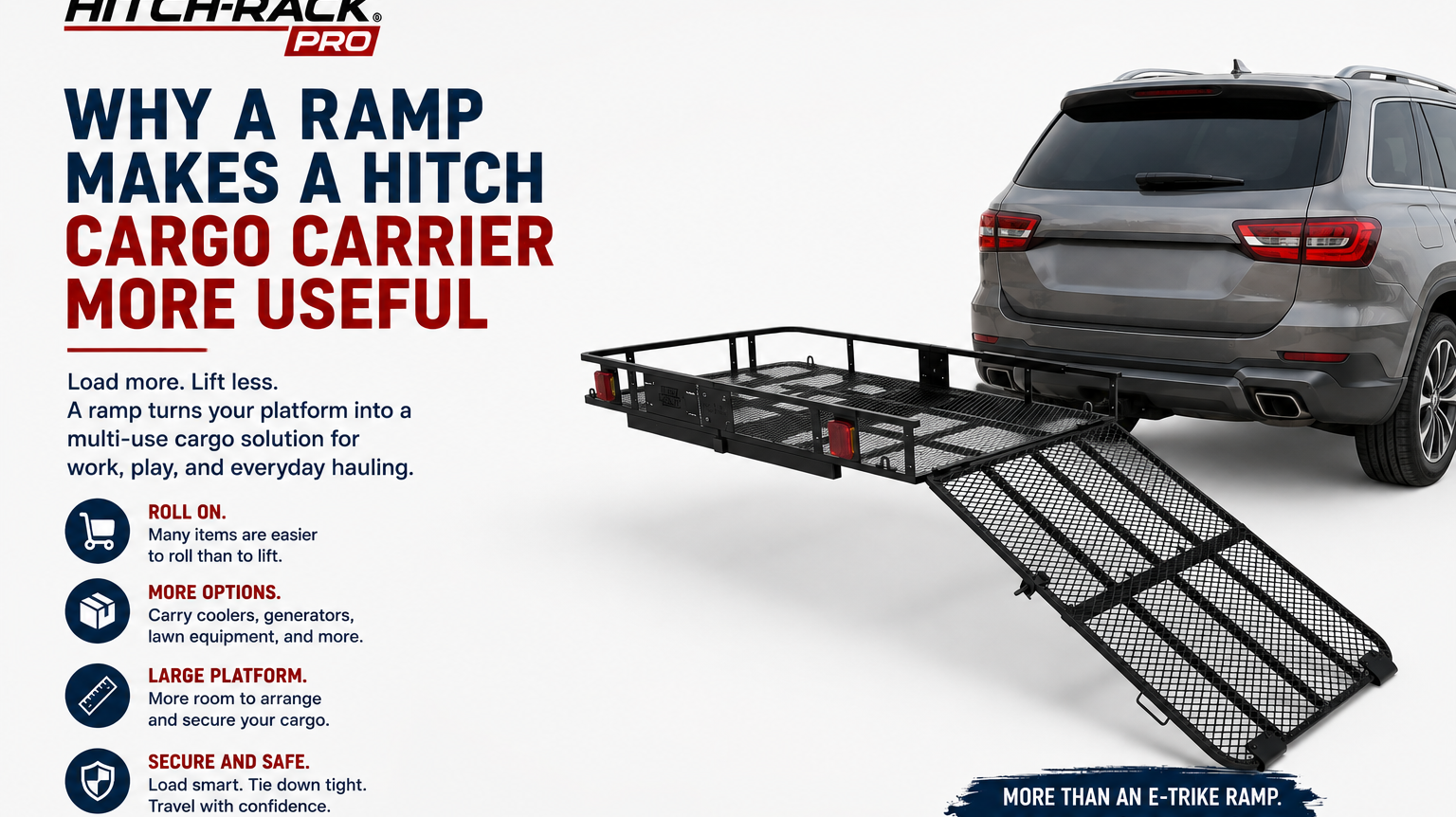
Look for a Loading Ramp
Once you've found a carrier that can physically accommodate your e-trike, think about how you're going to get the trike onto it.
That's where a loading ramp can make a major difference.
Rather than lifting the entire trike onto the carrier, a ramp allows you to roll it up onto the platform.
For a heavy electric trike, that can make loading and unloading considerably easier.
It can also make taking your trike along more practical.
After all, a carrier isn't very useful if loading the trike is such a difficult job that you avoid using it.
Don't Forget Your Vehicle's Hitch
Finding a carrier that fits your e-trike is only part of the equation.
You also need to determine whether your vehicle and receiver hitch are appropriate for the complete loaded system.
A hitch-mounted carrier places weight behind the vehicle.
That load includes:
the carrier + the e-trike + anything else mounted on the carrier.
Check your vehicle owner's manual and hitch specifications for applicable limits and requirements.
Never determine compatibility simply by looking at the receiver size.
Measure Before You Buy
One of the best things you can do before shopping for an e-trike carrier is spend a few minutes with a tape measure.
Record the important dimensions and weight of your trike.
Then compare those measurements against the carrier specifications.
It's much easier to identify a compatibility issue in your driveway with a tape measure than after you've purchased a carrier.
What Kind of Rack Should You Use for an E-Trike?
For most electric trikes, look for a hitch-mounted carrier specifically designed to accommodate e-trikes.
The carrier should be appropriate for the trike's weight and dimensions and compatible with your hitch and vehicle.
Useful features may include:
-
A platform designed for three-wheel cycles
-
Adequate weight capacity
-
Compatibility with wider tires
-
Adjustable wheel positioning
-
Secure attachment points
-
A loading ramp
-
Construction designed for heavier electric cycles
The exact features you need will depend on your particular e-trike.
The Bottom Line
So, can you put an e-trike on a regular bike rack?
Usually, no—and trying to make a standard rack work can create more problems than it solves.
An e-trike isn't simply a bicycle with another wheel. Its weight, width, wheel configuration, and loading requirements call for a different type of carrier.
At Hitch-Rack Pro, we design hitch-mounted carriers around the realities of transporting e-trikes and e-bikes.
The goal is straightforward: make it easier to load your ride, secure it properly, and take it with you when you're ready to travel.
Because owning an e-trike gives you more places to ride.
Your carrier should help you get there.
Frequently Asked Questions
Will a regular e-bike rack hold an e-trike?
Usually not. Even if an e-bike rack has sufficient weight capacity, its wheel trays and support system are typically designed for two-wheel bicycles rather than the three-wheel configuration and width of an e-trike.
Can I carry an e-trike on a 2-inch hitch?
Potentially, but receiver size alone doesn't determine compatibility. You need to verify the requirements and capacities of the carrier, receiver hitch, and vehicle for the complete loaded weight.
Can I use a platform bike rack for an e-trike?
Only if the platform carrier is specifically designed or approved by its manufacturer for your type and size of e-trike. A conventional two-wheel platform rack shouldn't be assumed to work simply because it looks similar.
Should I remove the battery before transporting my e-trike?
Follow the recommendations of your e-trike and battery manufacturer. Removing a removable battery may reduce the weight being loaded onto the carrier, but it doesn't change the rated limits of the carrier, hitch, or vehicle.
What's the easiest way to load an e-trike onto a carrier?
A properly designed loading ramp can allow you to roll the trike onto a low hitch-mounted platform rather than lifting the entire trike.