
How Much Strength Does It Take to Use a Hitch-Rack Pro?
One of the most important questions to ask before purchasing an eTrike rack is simple:
Can I physically handle it?
A rack can fit your vehicle and your eTrike perfectly, but that doesn't matter if it's too difficult for you to use comfortably.
Many Hitch-Rack Pro customers are seniors, and some have limited strength or mobility. That's one reason we've designed our system to reduce lifting and make as many steps as possible easier to manage.
But there are still a few physical tasks you'll need to perform.
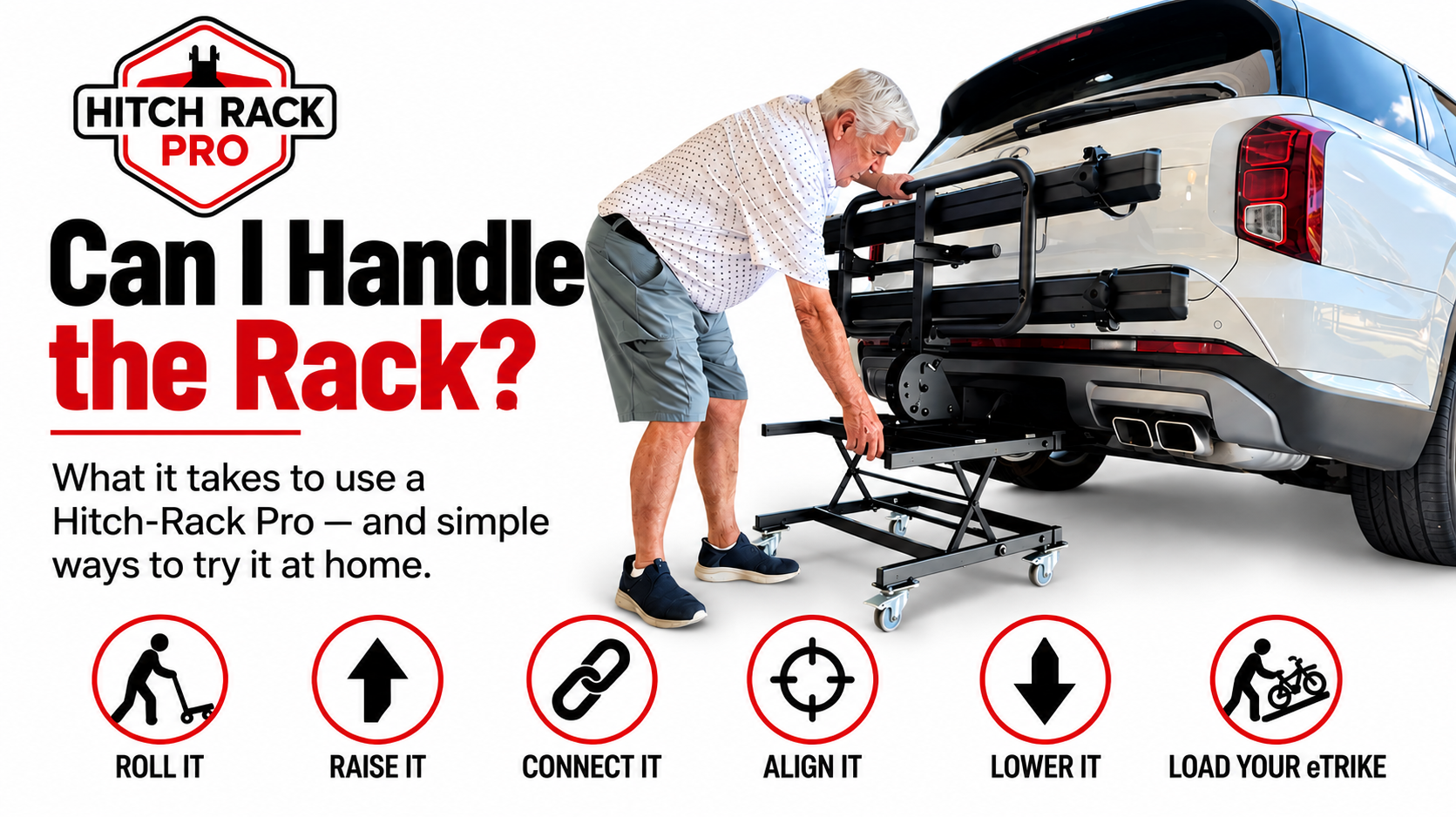
This guide will walk you through them — and give you some simple things you can try at home before purchasing.
The 5 Physical Tasks to Consider
Using your Hitch-Rack Pro involves five main physical activities:
1. Rolling the rack to your vehicle
2. Connecting the rack to the hitch receiver
3. Lowering the rack into the loading position
4. Pushing your eTrike up the ramps
5. Controlling and securing the eTrike
Let's look at each one.
1. Can You Move the Rack to Your Vehicle?
You don't need to pick up and carry the rack.
With the Rack Lift, the weight of the rack is supported while you roll it into position behind your vehicle.
On a smooth, level surface, moving the rack takes approximately 10 pounds of pushing or pulling force.
Try This at Home
A simple way to get a feel for 10 pounds of pushing force is to try moving everyday wheeled objects on a smooth, level surface.
For example, try:
-
Rolling a loaded suitcase across a hard floor
-
Moving a full-size wheeled trash can on a smooth driveway
-
Pushing a moderately loaded shopping cart
These aren't exact comparisons — wheel size, surface and load all make a difference — but they can help you think about whether you're comfortable pushing and steering something on wheels.
Important: Uneven pavement, gravel, slopes and cracks can require considerably more effort. The approximately 10-pound figure applies to a smooth, flat surface.
2. Can You Connect the Rack to the Vehicle?
This is where people often assume they'll need to lift the rack.
You don't.
The Rack Lift does the heavy work.
You roll the rack behind the vehicle and crank the Rack Lift until the rack's hitch bar is at the correct height.
Cranking requires only a small amount of effort.
Once the rack is at the proper height, you roll it forward and slide the hitch bar into the vehicle's receiver.
When everything is properly aligned, very little pushing force should be required.
Finding the Hitch-Pin Hole
One frustrating part of installing many hitch accessories is trying to determine when the holes in the hitch and receiver are lined up.
That's why we developed the Hitch Hole Finder Tool.
It helps you determine when the hitch holes are aligned so you aren't repeatedly pushing, pulling and bending down trying to find the correct position.
Try This at Home
Think less about lifting and more about whether you're comfortable performing these movements:
Can you turn a hand crank?
Try slowly turning the handle on a manual can opener or another hand-cranked household or yard item.
Can you push something forward while standing?
Try rolling a loaded suitcase toward a wall and gently controlling the last few inches of movement.
Can you work around the hitch area of your vehicle?
Stand behind your vehicle and consider whether you're comfortable reaching and working around the receiver area.
You shouldn't need to lift the weight of the rack. The Rack Lift is there to do that job.
3. Can You Lower the Rack Into Position?
For many customers, this may be the most important strength consideration.
Once the rack is attached to the vehicle, you'll need to lower it from its upright/storage position into the horizontal loading position.
The amount of weight you will be controlling is approximately 40 pounds.
This isn't the same as picking up a 40-pound object from the floor. You're controlling part of the rack as it pivots downward.
However, you should be comfortable controlling approximately that amount of weight.
Try This at Home
If you want a conservative test, find a household object weighing approximately 35–40 pounds that you can safely control with both hands.
Don't try lifting 40 pounds from the floor just to test yourself.
Instead, have the object positioned at a comfortable height and see whether you can safely support and control some of its weight with both hands.
Another comparison might be slowly controlling a moderately heavy garage, patio or folding item as it moves downward.
The important question isn't:
“Can I lift 40 pounds?”
It's:
“Can I safely control resistance of roughly this amount while something moves downward?”
If you're unsure, having another person assist with this step may be the best option.
4. Can You Push Your eTrike Up the Ramps?
This is one area where the amount of effort can vary considerably.
The force required depends on several things, including:
-
The weight of your eTrike
-
The rolling resistance of its tires
-
The ramp angle
-
The height of your vehicle's hitch
-
Whether you're loading on perfectly level ground
-
Your body position and ability to push
Because of these variables, we don't want to give you a number that may not accurately represent your situation.
Try This at Home
Here's a practical test you can perform using your own eTrike.
With the motor turned off, stand in the position you would normally use to push your eTrike.
Start on flat pavement and push the trike several feet.
Then, if you have access to a very gentle incline with safe footing, try pushing it uphill a short distance.
Do not use a steep hill as a test.
You're trying to answer three questions:
Can I get the trike moving comfortably?
Can I continue pushing while it has some resistance?
Can I stop and safely control it if necessary?
If pushing your eTrike on even a slight incline is difficult, loading it onto a ramp may require assistance.
5. Can You Control the eTrike While Loading?
Pushing isn't the only challenge when loading an eTrike.
You also have to keep the handlebars straight.
A heavy eTrike can become much more difficult to manage when the front wheel turns unexpectedly while you're trying to push it up a ramp.
That's why Hitch-Rack Pro developed the EasyRatch Method.
The EasyRatch Method
Using our self-retracting ratchet straps, one strap is attached to each side of the handlebars and run back toward the seat or rear basket.
This stabilizes the handlebars and helps prevent the front wheel from flopping from side to side.
Instead of trying to push and steer at the same time, you can concentrate much more of your effort on simply pushing the eTrike up the ramps.
For riders with limited strength, balance or mobility, that can make loading much more manageable.
A Simple At-Home Checklist
Before purchasing, consider trying these activities.
☐ Roll something on wheels.
Can you comfortably push and steer a loaded suitcase, trash can or similar wheeled object across a smooth surface?
☐ Turn a hand crank.
Can you comfortably make repeated turns with one hand?
☐ Work around your vehicle's hitch.
Can you comfortably stand behind the vehicle, reach the receiver area and install or remove a hitch pin?
☐ Control moderate resistance with both hands.
Can you safely control approximately 35–40 pounds of resistance without feeling unstable?
☐ Push your eTrike.
With the motor off, can you comfortably push your actual eTrike across level pavement?
☐ Try a slight incline.
Can you safely push and control your eTrike up a gentle incline?
If you can comfortably perform these types of movements, there's a good chance you'll be able to manage the major physical steps involved in using the Hitch-Rack Pro system.
You Don't Have to Be Able to Lift the Rack
This is an important distinction.
A heavy-duty eTrike rack may weigh a substantial amount, but rack weight and the amount of strength required to use the rack are not the same thing.
The Rack Lift is designed to support the rack's weight while you:
Roll it.
Raise it.
Align it.
Connect it.
The Hitch Hole Finder Tool helps with alignment.
The EasyRatch Method helps control the eTrike during loading.
Each of these features addresses a different part of the process.
Our goal is not to make you stronger.
Our goal is to design the system so you don't have to be.
Still Not Sure?
Everyone's physical abilities are different.
Age alone doesn't determine whether you'll be able to use the rack. Strength, balance, grip, mobility, your vehicle, your driveway and the weight of your eTrike can all make a difference.
If you're concerned about a particular step, don't guess.
Contact Hitch-Rack Pro before you order.
Tell us:
-
What eTrike you own
-
What vehicle you drive
-
Which part of the process concerns you
-
Whether you'll normally be loading by yourself
We'll help you understand what that part of the process involves so you can make an informed decision before purchasing.
The right rack isn't just one that carries your eTrike. It's one you can actually use.