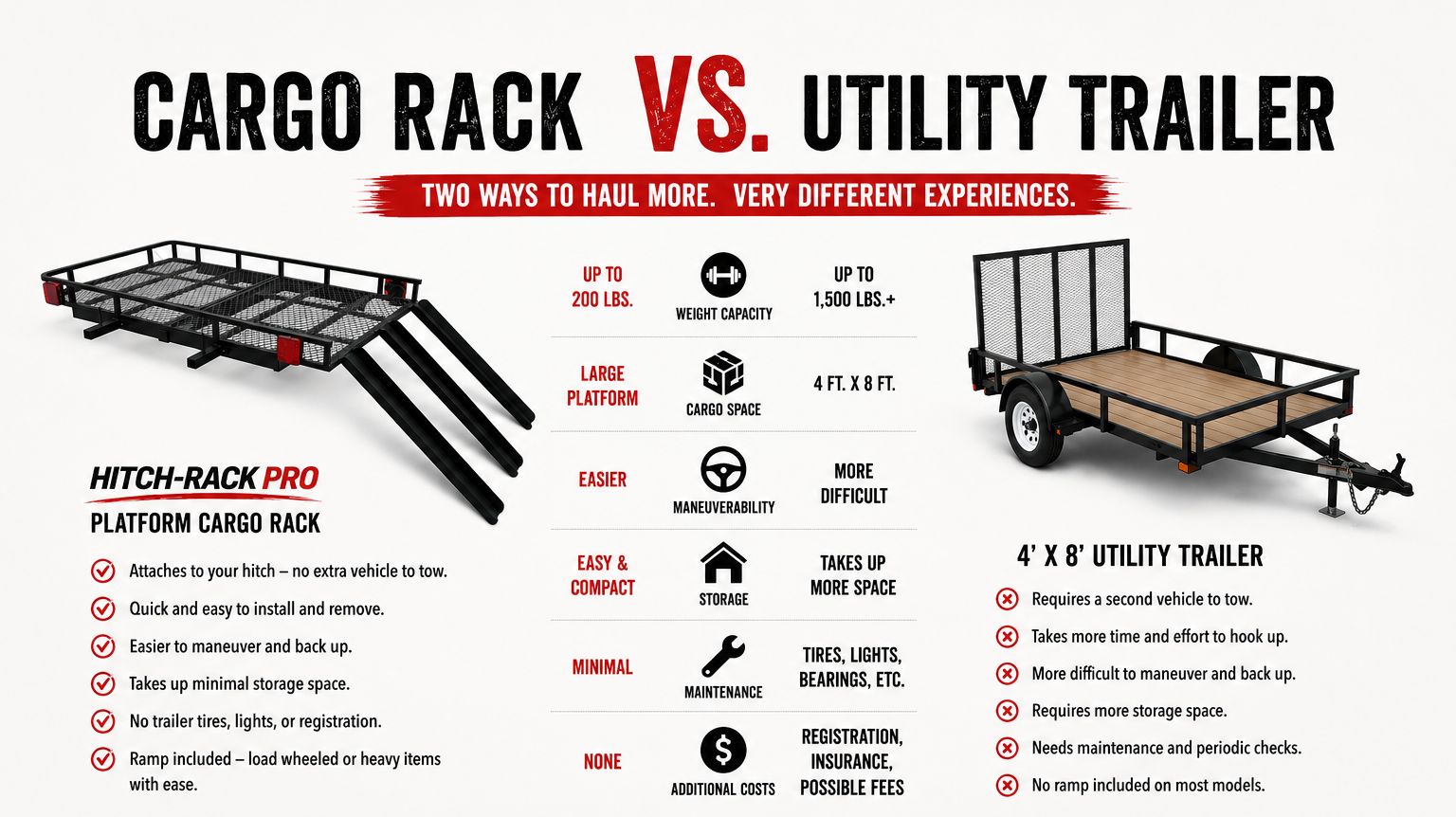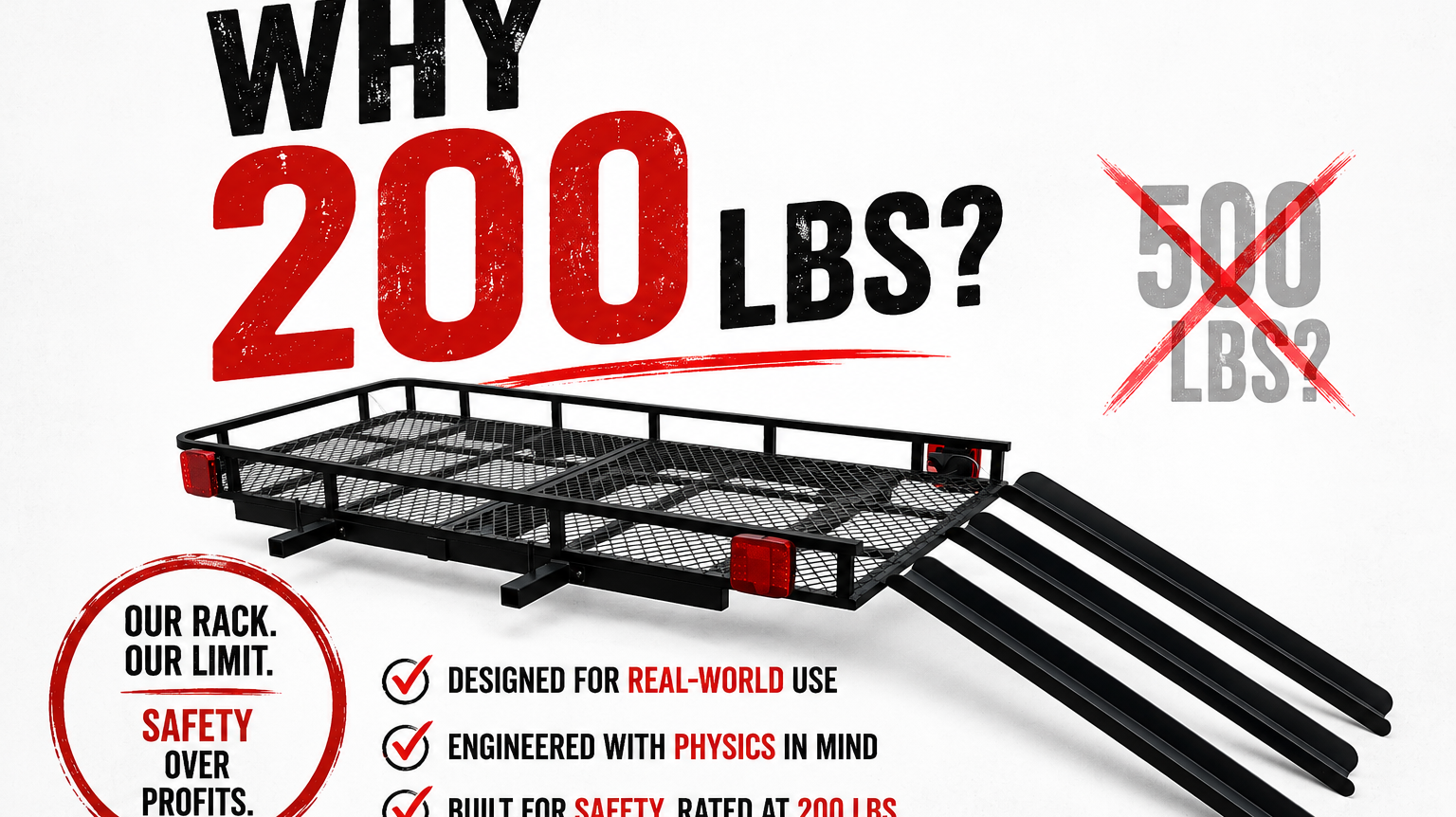

Flat Towing With an E-Trike Rack: A Better Option for Class A and Class C Motorhomes
If you own a Class A or Class C motorhome and want to bring an e-trike along, you may have run into an important problem: mounting a heavy platform rack directly to the back of the motorhome isn't always a good idea.
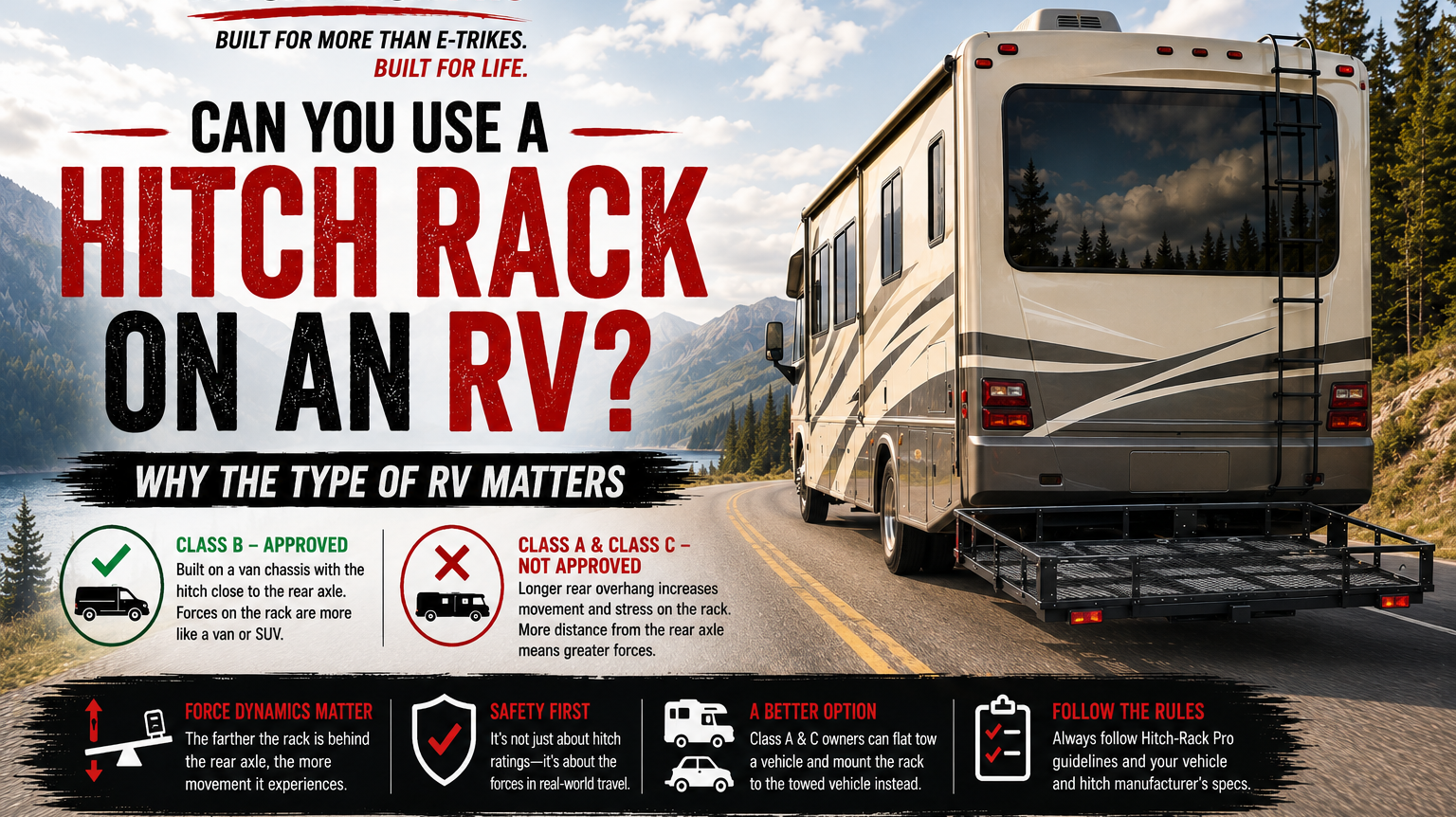
As we discussed in our previous article, large motorhomes can have substantial distance between the rear axle and the hitch. That long rear overhang can amplify the movement experienced by a hitch-mounted rack.
But many Class A and Class C owners already travel with another vehicle behind them.
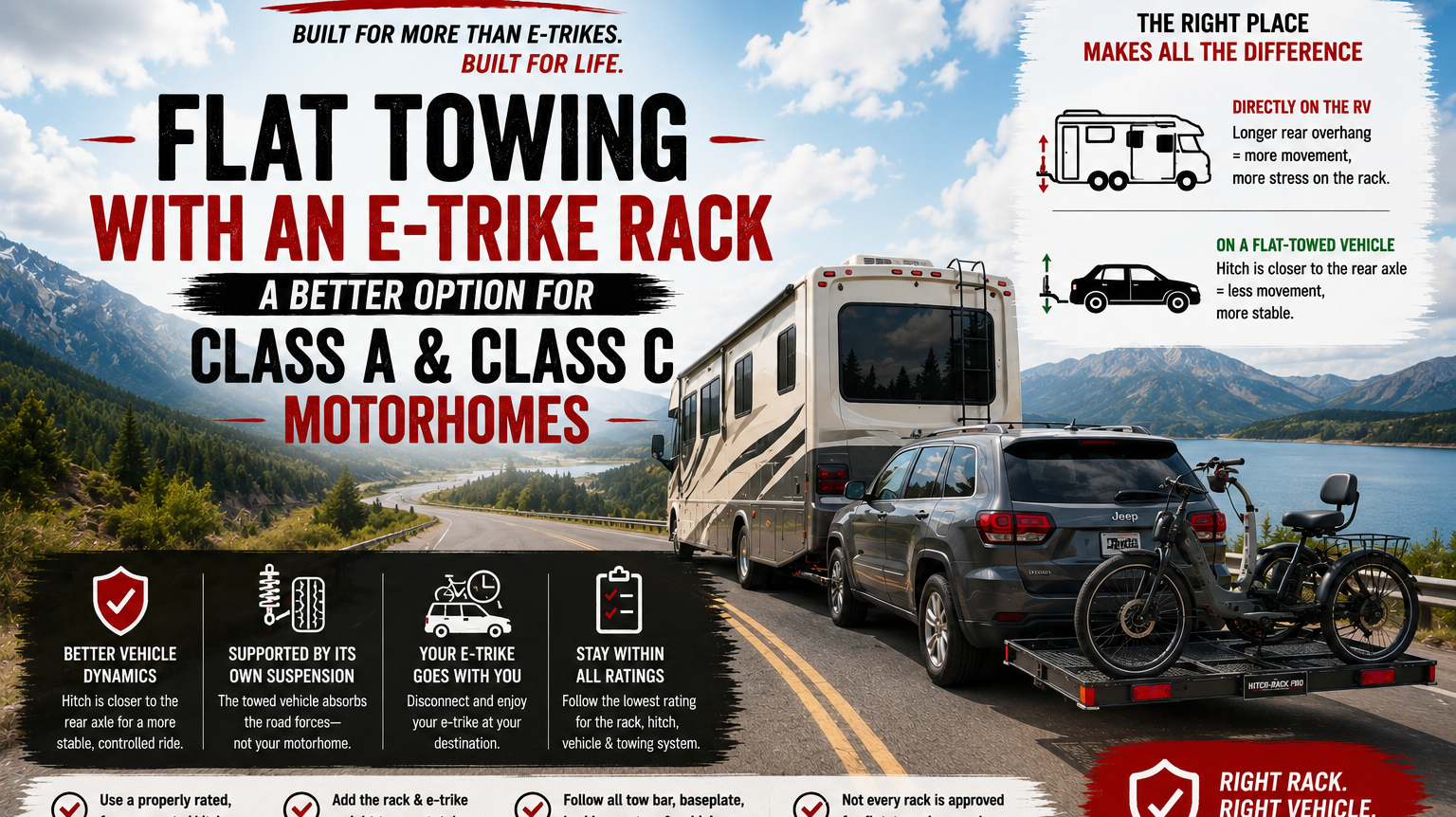
If you're flat towing a properly equipped vehicle, that vehicle can provide a much better location for your Hitch-Rack Pro carrier.
Instead of Mounting the Rack to the RV, Mount It to the Towed Vehicle
The basic setup is straightforward.
The motorhome flat tows a compatible car or SUV, sometimes called a toad or dinghy vehicle.
The Hitch-Rack Pro carrier is then installed in the appropriate receiver hitch at the rear of the flat-towed vehicle, rather than directly on the motorhome.
So the configuration becomes:
Motorhome → Tow Bar → Flat-Towed Vehicle → Hitch-Rack Pro Carrier → E-Trike
This arrangement changes where the rack is supported and, more importantly, changes the forces acting on it.
Why This Is Different From Mounting the Rack Directly to the RV
Think about a large Class A motorhome from the side.
The rear wheels may be located several feet forward of the back of the motorhome. The hitch is even farther behind those wheels, and then the cargo carrier extends farther still.
That creates a long lever.
As the rear wheels travel over bumps and dips, movement can become amplified by the time it reaches the carrier.
Now look at a typical passenger vehicle.
The rear hitch is usually much closer to the rear axle. That shorter distance reduces the lever-arm effect that can create excessive movement at the back of a motorhome.
Mounting the rack to the flat-towed vehicle doesn't eliminate road forces, but it puts the carrier in a much more favorable location relative to the vehicle's rear axle.
The Towed Vehicle Has Its Own Suspension
There's another important difference.
The flat-towed vehicle is still riding on its own four wheels and suspension.
The tow bar connects the vehicle to the motorhome, but the motorhome isn't physically carrying the weight of the car, rack, and e-trike.
The car supports itself.
Likewise, the rack is attached to the rear of that vehicle and supported through its hitch, chassis, suspension, and tires.
That's very different from hanging the rack directly from the end of a long motorhome rear overhang.
Flat Towing Doesn't Make the Rack Weightless
There's an important limitation to understand.
Moving the rack to the towed vehicle doesn't mean you can ignore weight ratings.
The rack and e-trike still place weight on the rear of the towed vehicle.
You must have an appropriate receiver hitch, and the vehicle must be capable of supporting the rack and its cargo.
You also need to consider the combined weight of the carrier and e-trike, not simply the weight of the trike.
And, as always, the lowest applicable rating determines the limit.
If the rack can handle more than the vehicle or hitch allows, you must follow the lower vehicle or hitch limitation.
The Added Weight Also Matters When Flat Towing
There's another number RV owners need to consider: the total weight being towed behind the motorhome.
Adding a carrier and e-trike increases the weight of the flat-towed setup.
For example, if your towed vehicle weighs 4,000 pounds and you add a rack and e-trike totaling another 300 pounds, the motorhome is now pulling approximately 4,300 pounds, before considering any additional cargo in the vehicle.
That additional weight needs to remain within the applicable towing limitations of the motorhome, tow bar, baseplate, and other components in the flat-towing system.
Don't look at the rack as an isolated accessory. It's part of the complete towing configuration.
Don't Forget the Tow Bar and Flat-Tow Equipment
The rack isn't the only equipment involved.
A proper flat-towing setup can include a tow bar, vehicle-specific baseplate, safety cables, supplemental braking system, lighting system, and other components.
Every component has to be appropriate for the application.
Adding an e-trike carrier to the back doesn't change the need to follow the requirements established by the motorhome, vehicle, tow-bar, baseplate, braking-system, and hitch manufacturers.
Watch Your Overall Length
Mounting a platform rack behind a flat-towed vehicle also makes the entire combination longer.
You now have:
Motorhome + tow-bar space + vehicle + cargo carrier.
Depending on the motorhome and vehicle, that can create a substantial overall length.
RV owners should make sure their complete setup complies with applicable state and local requirements and remains practical for the places they intend to travel.
The carrier also extends beyond the rear of the towed vehicle, so you'll need to account for that additional length when maneuvering and parking after disconnecting from the motorhome.
Make Sure Lights and Visibility Aren't Obstructed
An e-trike mounted behind a vehicle can potentially interfere with visibility of the vehicle's taillights or license plate.
That's something that should be evaluated whenever you're transporting an e-trike—not just while flat towing.
Your lighting and license plate must remain compliant with applicable requirements.
The same applies to the carrier itself. Make sure everything is properly secured before traveling and periodically inspect the rack, hitch connection, e-trike tie-downs, and flat-towing equipment during a trip.
Not Every Hitch Rack Is Approved for Flat-Towed Vehicles
This point is especially important.
You shouldn't assume that because a rack can be used behind a car or SUV, it can automatically be used on that same vehicle while it's being flat towed.
Flat towing creates different operating conditions, and some rack manufacturers specifically prohibit their products from being used on flat-towed vehicles.
Always follow the rack manufacturer's instructions.
Hitch-Rack Pro permits the appropriate flat-towed-vehicle configuration when all of our requirements are met, but that doesn't mean the same is true for every carrier.
A Practical Solution for Class A and Class C Owners
For many RV owners, flat towing is already part of how they travel.
They arrive at a campground, disconnect the vehicle, and then use that vehicle for sightseeing, shopping, restaurants, trailheads, and exploring the surrounding area.
Putting the e-trike carrier on that vehicle has another advantage:
Your e-trike goes with the vehicle after you disconnect from the motorhome.
You don't have to leave the rack attached to the RV.
Once you're at your destination, your car or SUV can transport the e-trike to bike paths, parks, beaches, downtown areas, or wherever else you want to ride.
That makes the arrangement useful both while traveling and after you arrive.
Put the Rack Where the Vehicle Dynamics Make More Sense
The reason Hitch-Rack Pro doesn't approve direct mounting to Class A and Class C motorhomes isn't because we don't want RV owners using our products.
It's because mounting a heavy platform several feet behind a motorhome's rear axle can create forces we don't believe should be ignored.
Flat towing can provide another option.
By mounting the rack to a properly equipped towed vehicle, the carrier is placed much closer to that vehicle's rear axle and supported through a conventional automotive chassis and suspension.
You still need the correct equipment. You still need to stay within every applicable weight rating. And the entire flat-towing system must be properly configured.
But for Class A and Class C owners who already flat tow a suitable vehicle, it can be a much better way to bring an e-trike along.
Sometimes the solution isn't a stronger rack. It's putting the rack in the right place.