



Why Does Hitch-Rack Pro Have a 200 lb. Weight Limit?
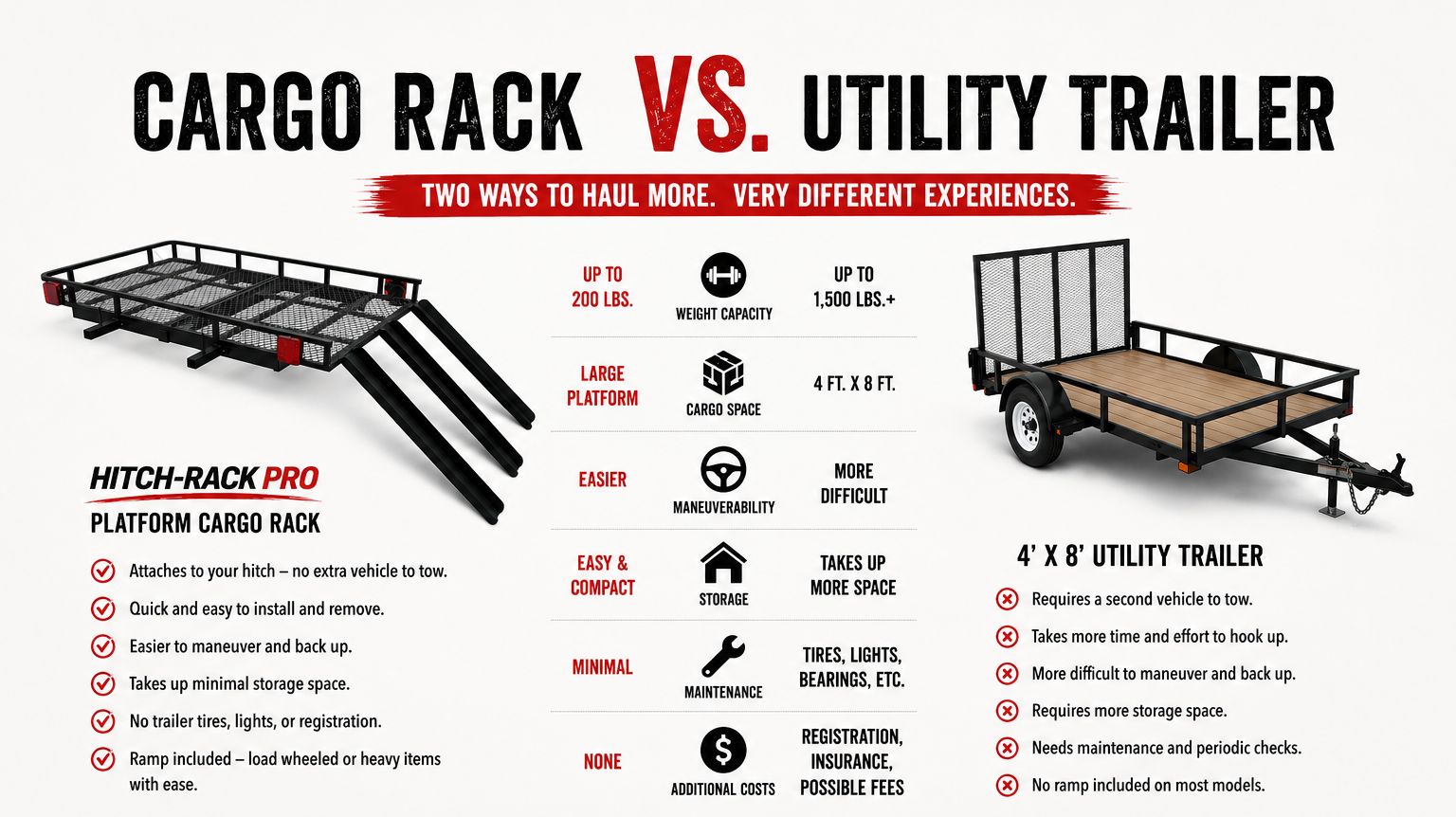
If you've shopped for hitch-mounted platform racks online, you've probably seen some impressive weight-capacity claims. Some racks—particularly inexpensive models sold through Amazon and factory-direct sellers—advertise capacities of 400 or even 500 pounds.
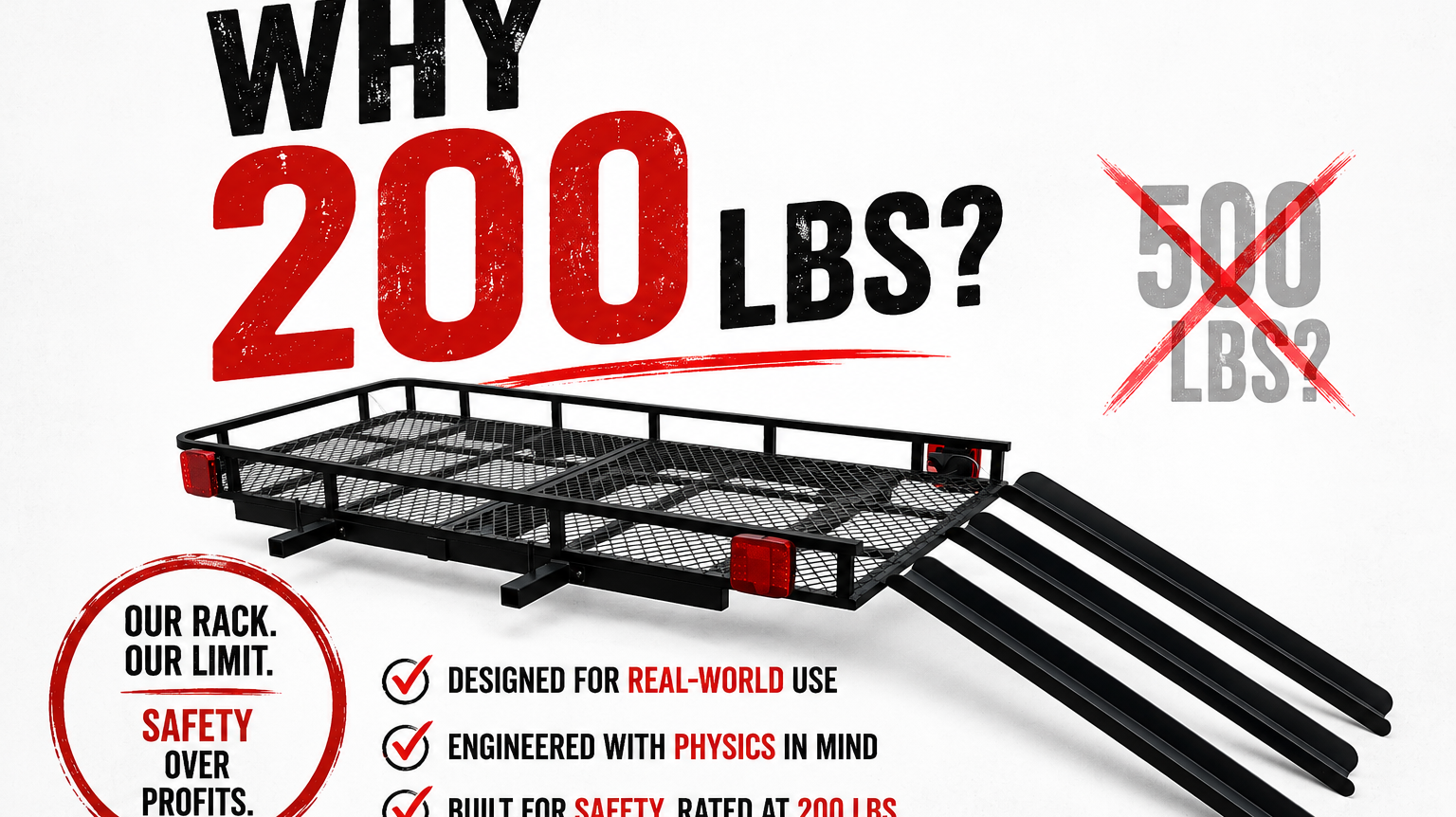
Hitch-Rack Pro has a 200 lb. maximum load capacity.
Why would we put a lower number on our rack when a larger number might help us sell more of them?
Because the amount of weight a platform can hold while sitting still isn't the same as the amount of weight it should carry behind a moving vehicle.
There are several factors that determine a responsible weight rating, and the first is basic physics.
Distance From the Hitch Matters
A hitch-mounted platform acts like a lever.
The receiver supports the carrier at the vehicle, while the platform and its load extend behind that support point. The farther the load's center of gravity is from the hitch, the more leverage it creates.
An easy way to understand this is to hold a weight against your chest and then hold the same weight straight out in front of you.
The weight didn't get heavier, but it certainly feels heavier.
That's because you've increased its distance from the point supporting it.
The same principle applies to a hitch carrier. A 200-pound load positioned close to the receiver doesn't create the same forces as a 200-pound load positioned farther away.
This is particularly important with large e-trike platforms.
Many conventional cargo carriers are smaller, narrower, and lighter. A platform large enough to accommodate an e-trike has to extend farther from the vehicle, which increases the leverage placed on the carrier and hitch.
That's one reason comparing platform racks based only on advertised weight capacity can be misleading.
A Moving Vehicle Changes Everything
There's also a major difference between placing weight on a rack in the shop and transporting that weight down the highway.
A stationary load creates a relatively constant force.
A carrier on the road experiences bumps, potholes, dips, vibration, braking, acceleration, and movement of the vehicle itself.
When the back of the vehicle moves upward after hitting a bump, it also accelerates the carrier and its load. That movement can momentarily create forces much greater than the weight of the cargo sitting still.
The farther the load is positioned behind the receiver, the more important those forces become.
So when evaluating a carrier, the question shouldn't simply be:
"How much weight can we put on this platform before it bends?"
The real question is:
"How much weight should this carrier transport behind a moving vehicle under real-world conditions?"
That's the question our rating is intended to answer.
The Vehicle and Hitch Have Limits
No matter how strong a carrier is, it's still attached to a receiver hitch—and that hitch is attached to a vehicle.
A carrier advertised for 500 pounds doesn't give the vehicle a 500-pound capacity.
The vehicle and receiver hitch have their own ratings and restrictions, and the weight of the carrier itself also contributes to the load being supported by the vehicle.
This is particularly important with heavy-duty platform carriers because the rack itself can be substantial before an e-trike or any cargo is added.
A 2-inch receiver doesn't automatically mean a vehicle can handle a heavy platform carrier. It simply describes the receiver size.
Owners should always verify the applicable specifications for their particular vehicle and hitch.
E-Trikes Don't Distribute Their Weight Evenly
E-trikes present another challenge that doesn't show up in a simple weight-capacity number.
Their weight isn't necessarily distributed evenly across the platform.
The motor, battery, drivetrain, frame design, baskets, cargo, and the end of the trike with two wheels can make one portion of an e-trike considerably heavier than another.
That matters to the carrier.
Imagine placing 200 pounds evenly across an entire platform. Now imagine placing a large percentage of those 200 pounds near one area of the platform.
The total weight is still 200 pounds, but the stress on individual parts of the carrier can be very different.
A rack can generally support a given amount of weight more favorably when that weight is evenly distributed.
Since our carriers are specifically intended for e-trikes, we base our decisions on the kinds of loads customers will actually put on them—not an ideal load spread perfectly across the platform.
Be Careful With 500 lb. Capacity Claims
This brings us to some of the weight ratings you'll see online.
There are platform racks sold on Amazon and directly from overseas factories claiming capacities of 500 pounds or more.
We're not saying that every imported rack is unsafe. Quality products are manufactured all over the world.
But a very high capacity claim for a hitch-mounted platform should come with enough information for the customer to understand what that number actually means.
Was it determined by placing evenly distributed weight on a stationary platform?
Was the carrier tested with the load positioned far from the receiver?
Does the rating account for dynamic forces while driving?
What type of vehicle and hitch are required?
Does the stated capacity include restrictions on how the weight must be distributed?
If those questions aren't answered, the number alone doesn't tell you very much.
A rack surviving 500 pounds placed evenly across it while sitting on a test fixture does not necessarily mean carrying 500 pounds several feet behind a vehicle is appropriate.
Who Stands Behind the Claim?
There's another consideration when comparing products sold through online marketplaces: accountability.
Some racks are sold factory-direct by overseas companies with little or no permanent U.S. presence.
If a seller makes an unrealistic capacity claim and something goes wrong, holding that company accountable may be considerably more difficult than dealing with a U.S.-based business.
Listings can disappear. Seller names can change. Obtaining support or pursuing a company located in another country can be difficult.
Again, where a product is manufactured doesn't determine whether it's good or bad.
The issue is whether the company making the claim is prepared to stand behind the product and the capacity it advertises.
Hitch-Rack Pro is a U.S.-based company. Our name is attached to our products, our specifications, and the claims we make about them.
We take that responsibility seriously.
Why Our Limit Is 200 Pounds
Hitch-Rack Pro's 200 lb. load limit reflects the way our carrier is actually designed to be used.
It's a large platform capable of accommodating e-trikes. Those trikes can create concentrated and uneven loads. The platform extends behind the receiver, where leverage becomes an important consideration, and the carrier will experience dynamic forces while traveling.
Rather than advertising the largest number we think we can put on a product page, we've chosen a limit we believe is appropriate for the intended use of the carrier.
That doesn't mean every vehicle with a Hitch-Rack Pro carrier can automatically carry 200 pounds. The vehicle and receiver hitch must still be appropriate for the complete loaded setup.
And it doesn't mean the platform would suddenly fail if another pound were added. A rated capacity is a maximum operating limit, not a prediction of the exact point at which a product will break.
It's the limit we expect our customers to follow.
Safety Over Profits
We understand how people shop online.
When two similar products appear next to each other and one says 200 lbs. while another says 500 lbs., the larger number can look like the better product.
It can also make a product easier to sell.
But we're not willing to inflate a capacity rating simply to compete with claims we don't believe represent responsible real-world use.
Our customers are putting expensive e-trikes and equipment on these carriers and then traveling on public roads.
That's more important than winning a specification comparison.
At Hitch-Rack Pro, we choose safety over profits.


Comments
Do you have a rack with ramp that will fit 2 Lectric Trikes?