
Can You Use a Hitch Rack on an RV? Why the Type of RV Matters
One of the most common questions we receive about hitch-mounted racks is whether they can be used on an RV.
The answer isn't simply yes or no.
An RV may have a 2-inch receiver and a hitch with what appears to be plenty of tongue-weight capacity, but that doesn't automatically make it suitable for a heavy platform rack. The type of RV, the location of the rear axle, the distance between that axle and the hitch, and the construction of the hitch all affect the forces placed on a rack while traveling.
That's why Hitch-Rack Pro evaluates RV compatibility based on vehicle geometry and real-world dynamic forces, not simply the number stamped on the hitch.
Why the Rear Axle Matters
The easiest way to understand the problem is to think about riding in a school bus.
If you're sitting near the middle of the bus and it goes over a bump, you'll feel some movement.
Now imagine sitting in the very last row, several feet behind the rear axle. That same bump can produce considerably more up-and-down movement where you're sitting.
A hitch rack mounted behind a vehicle behaves in a similar way.
The farther the hitch is positioned behind the rear axle, the more the movement of the vehicle can be amplified at the rack. This is sometimes described as a lever-arm effect.
It's also why some rack manufacturers restrict RV use even when the RV has a substantial receiver hitch. The long distance between the rear axle and hitch can create significantly more movement and stress on hitch-mounted equipment than it would experience behind a typical passenger vehicle.
Static Weight Isn't the Whole Story
Imagine putting a 200-pound load on a rack while the vehicle is parked.
That's a static load.
Now take that same rack and load down a highway. The vehicle encounters dips, expansion joints, potholes, railroad crossings, driveway entrances, and other changes in the road surface.
The rack isn't simply supporting weight anymore.
It's moving up and down with the vehicle.
That movement creates dynamic loads. A load can momentarily place substantially different forces on the hitch, rack, and supporting structure than it does while everything is sitting still.
Rear overhang makes those forces especially important because movement occurring at the axle can become greater by the time you reach the hitch. RV technical discussions of tow-bar geometry describe this same phenomenon: vertical movement at the rear of a motorhome can exceed the road displacement at the rear wheels because the connection point is located behind the axle.
This is why looking only at a hitch's published tongue-weight capacity doesn't tell the entire story.
Why Class B Motorhomes Are Different
A Class B motorhome is essentially a van converted into a motorhome.
Examples are commonly built on platforms such as the Mercedes-Benz Sprinter, Ford Transit, and Ram ProMaster.
From the standpoint of a hitch-mounted rack, that distinction is important.
A Class B typically has a vehicle layout much closer to a conventional van. The rear hitch is relatively close to the rear axle compared with the long rear extensions commonly found on larger motorhomes.
That means the rack experiences forces much more like those encountered behind a passenger vehicle or heavy-duty van.
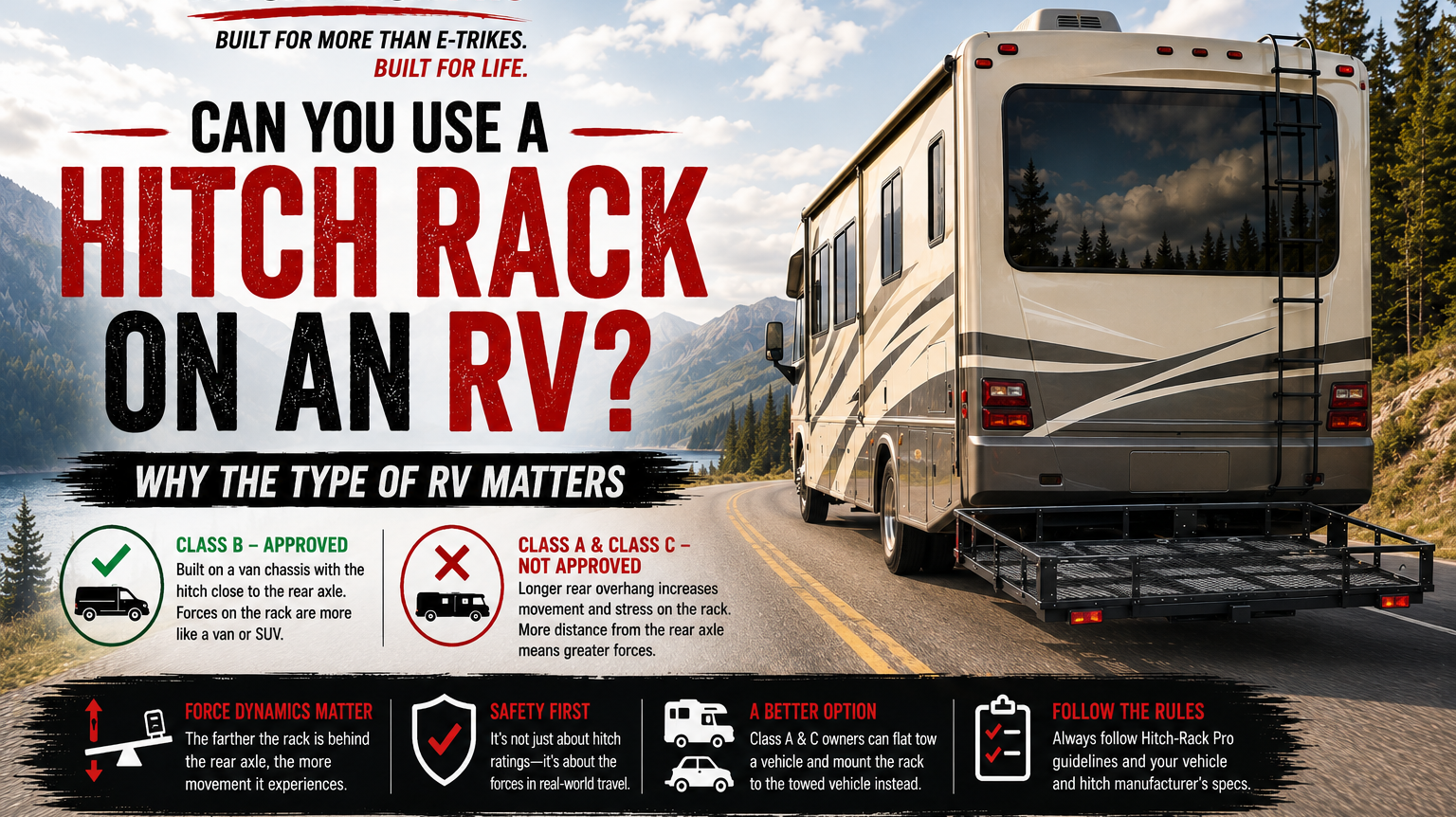
For that reason, Hitch-Rack Pro allows use on Class B motorhomes when the vehicle is equipped with an appropriate frame-mounted hitch and all applicable hitch and rack requirements are met.
The fact that an RV is a Class B doesn't eliminate the need to check the vehicle. You still need to verify that the receiver, vehicle, and rack are appropriate for the total loaded weight.
Why Class A Motorhomes Are Different
A Class A motorhome can be a completely different situation.
Look at one from the side and pay attention to where the rear wheels are located compared with the back of the motorhome.
There can be a considerable amount of vehicle extending behind the rear axle.
Then place a hitch rack behind that.
You've now moved the load even farther from the axle.
As the motorhome travels over uneven pavement, that long rear overhang acts like a lever. The rack at the very back can experience substantially more vertical movement than equipment mounted close to an axle.
There can also be another structural consideration. Some Class A motorhomes use rear frame extensions rather than having the hitch mounted directly to full-length chassis rails.
So even if the receiver itself has an impressive rating, we still have to consider what that receiver is attached to and what forces the entire structure will experience while driving.
For these reasons, Hitch-Rack Pro does not approve direct mounting of our racks to the rear of Class A motorhomes.
There is, however, another option for many Class A owners, which we'll cover shortly.
What About Class C Motorhomes?
A Class C may look more like a conventional truck or van from the front, which can make it seem as though hitch-rack use should be similar.
The problem is what happens behind the rear axle.
The motorhome body may extend considerably beyond the original chassis configuration. That can result in a long axle-to-hitch distance and rear frame extensions similar to the issues found on larger Class A motorhomes.
So although a Class C is generally smaller than a Class A, the same basic physics still apply.
For that reason, Hitch-Rack Pro does not approve mounting our racks directly to the rear of a Class C motorhome.
A Heavy-Duty Hitch Doesn't Eliminate the Physics
This is worth emphasizing because it's an easy mistake to make.
Someone may look at their RV hitch and say:
"My hitch is rated for more than the rack and e-trike weigh, so I should be fine."
That rating is important—but it isn't the only consideration.
A hitch rating doesn't change the distance between the hitch and rear axle. It doesn't eliminate the movement created by a long rear overhang, and it doesn't necessarily tell you how the rack itself will respond to repeated dynamic loading.
This is why two vehicles with similarly rated receivers may not be equally appropriate for the same hitch-mounted carrier.
Where the hitch is located matters.
What About Travel Trailers and Fifth Wheels?
The same reasoning is why Hitch-Rack Pro doesn't approve our racks for bumper-pull travel trailers or fifth-wheel trailers.
Travel trailers can produce substantial movement at the very rear because the trailer pivots at the tow vehicle and the rack may be located a long distance behind the trailer axle.
Fifth wheels are generally more stable at the tow vehicle because of where they connect to the truck, but they can still have considerable rear overhang behind their own axles.
In both cases, a rack mounted at the very rear can be subjected to forces very different from those it experiences behind a passenger vehicle.
But There Is an Option for Some Class A and Class C Owners
Not approving the rack directly on the back of a Class A or Class C doesn't necessarily mean those RV owners can't take their e-trike with them.
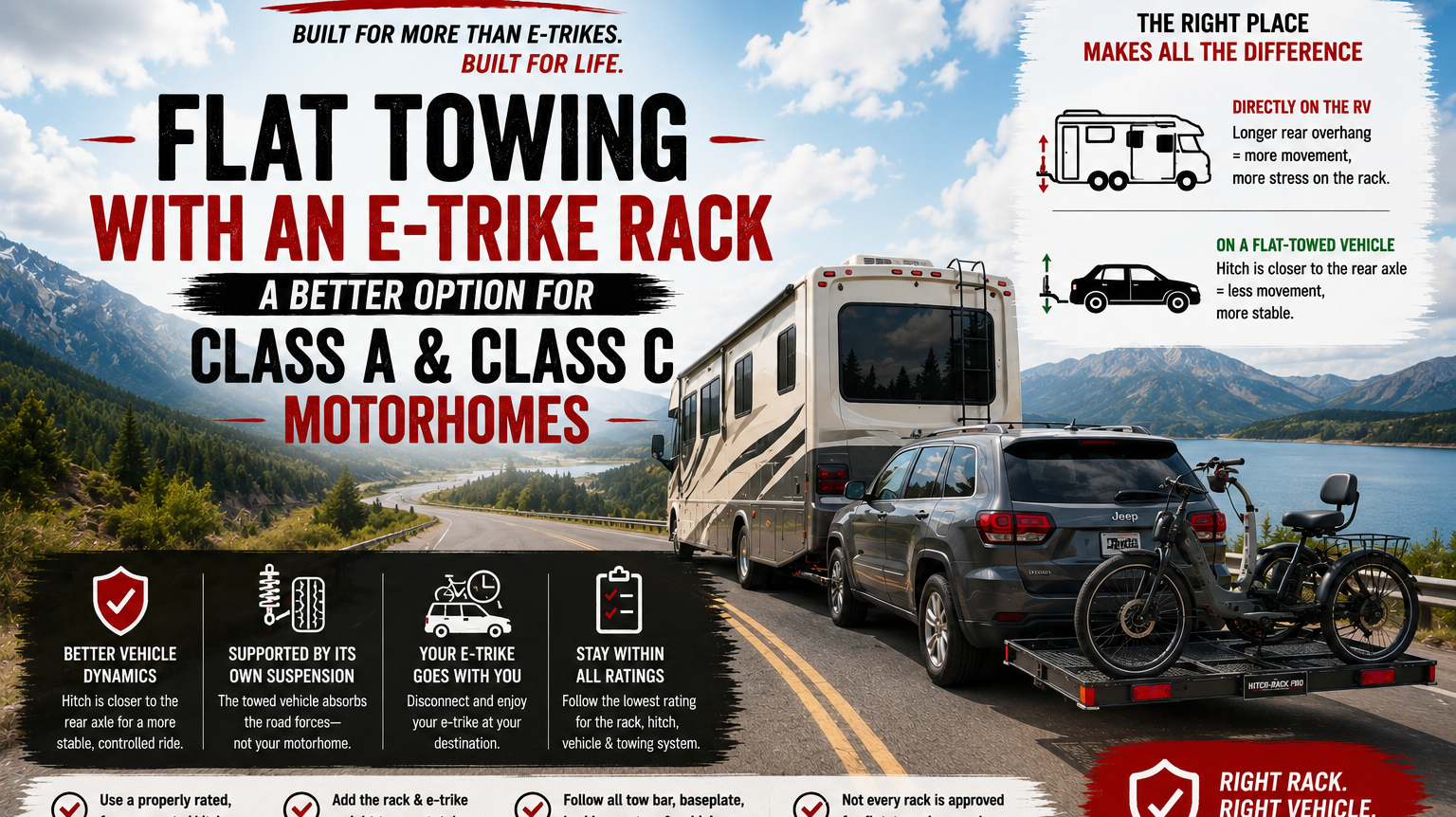
Many motorhome owners flat tow a car, SUV, or other vehicle behind the RV.
Instead of mounting the rack to the motorhome, the rack may be mounted to the proper hitch on the flat-towed vehicle, subject to Hitch-Rack Pro's requirements for that configuration.
That changes the geometry considerably.
The rack is now supported by the towed vehicle, with its own suspension and a much shorter distance between the rear axle and hitch. Instead of hanging several feet behind the rear axle of a large motorhome, the rack is positioned much more like it would be during normal automotive use. Hitch-Rack Pro's current RV policy specifically approves this arrangement for a Class A flat-towing a properly equipped vehicle.
We'll cover that setup—and why the physics are different—in a separate article.
Don't Ask Only, "Is My Hitch Strong Enough?"
When determining whether a hitch rack can be used with an RV, the better question is:
What forces will this rack experience where it's mounted?
That's why Hitch-Rack Pro doesn't make a blanket claim that our racks are simply "RV approved."
We distinguish between different configurations.
Class B motorhome with a properly rated, frame-mounted hitch? Approved when all applicable requirements are met.
Rack directly behind a Class A or Class C motorhome? Not approved.
Travel trailer or fifth wheel? Not approved.
That approach may be more restrictive than simply putting an "RV compatible" label on a product, but there's a reason for it.
The laws of physics don't change because a receiver has a certain number printed on its rating label.
At Hitch-Rack Pro, we'd rather explain why a particular configuration is appropriate—or why it isn't—than make a blanket claim that could put someone's equipment or safety at risk.