



If you own an e-bike or e-trike, getting it to your favorite trail, campground, beach, or vacation destination can present a challenge: What is the best way to transport it?
Two common options are a roof-mounted carrier and a hitch-mounted carrier. While both can work well for conventional bicycles, electric bikes—and especially electric trikes—introduce additional considerations.
They tend to be heavier, wider, and more difficult to lift than traditional bicycles. That makes factors such as weight capacity, loading height, stability, and vehicle compatibility especially important.
In this guide, we'll compare hitch carriers vs. roof carriers for e-bikes and e-trikes so you can determine which option makes the most sense for you.
What Is a Roof-Mounted Bike Carrier?
A roof carrier attaches to a vehicle's roof rack or crossbars and holds a bicycle above the vehicle.
Roof-mounted carriers have been popular with cyclists for years. They keep the rear of the vehicle unobstructed and can be a practical solution for relatively lightweight conventional bicycles.
The biggest challenge comes when the bike gets heavier.
Many electric bikes weigh considerably more than traditional bicycles. Getting a heavy e-bike from ground level to the roof of an SUV, crossover, truck, or van can require substantial lifting.
An e-trike presents an even greater challenge because of its additional wheel, wider stance, and overall size.
Before considering a roof carrier for an electric bike, always verify the weight limits of both the carrier and your vehicle's roof-rack system.
What Is a Hitch-Mounted Carrier?
A hitch-mounted carrier connects to a receiver hitch installed on the vehicle.
Depending on the design, the bike or trike may sit on wheel trays, rails, or a platform behind the vehicle.
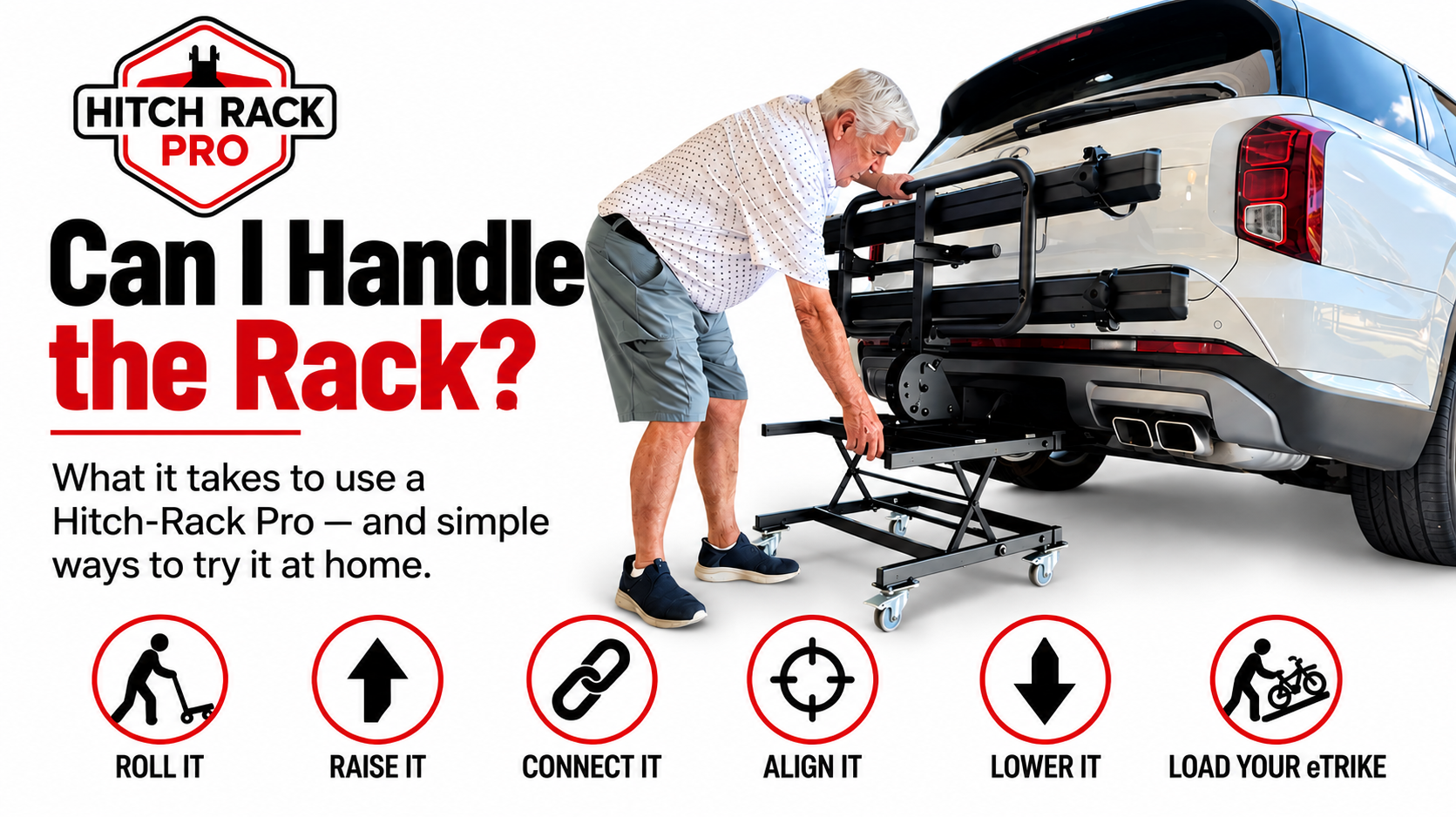
One of the biggest advantages is simple: the carrier is much closer to the ground.
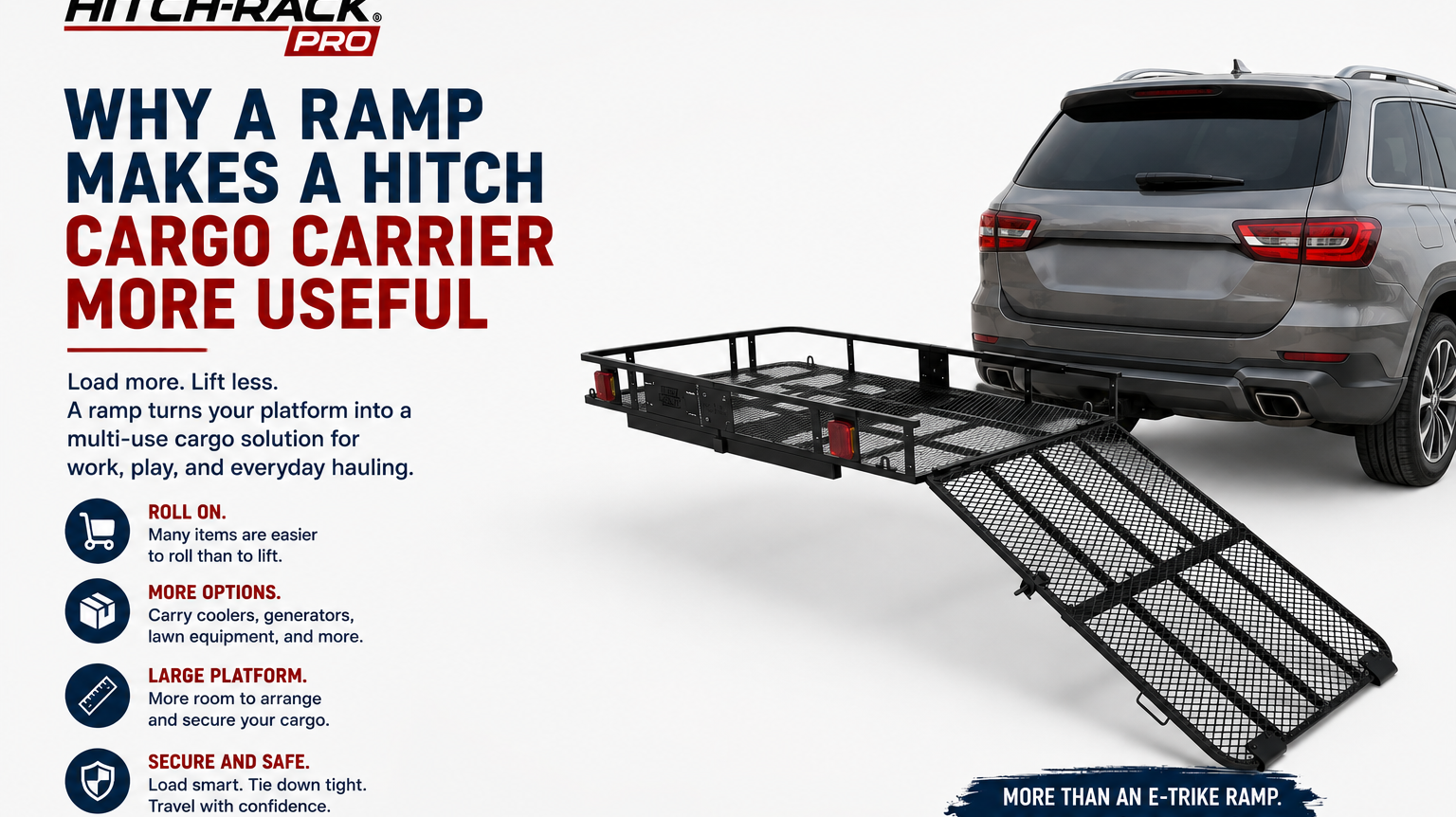
Instead of lifting an e-bike several feet overhead, you may only need to raise it a relatively short distance onto the carrier. A carrier equipped with a loading ramp can make the process even easier by allowing the bike or trike to be rolled into position.
For heavier electric bikes and e-trikes, that difference can be significant.
Hitch Carrier vs. Roof Carrier: The Key Differences
1. Loading Height
Loading height is probably the most noticeable difference between the two systems.
With a roof carrier, you must lift the bike from the ground to the top of your vehicle. Depending on the height of your vehicle, that can mean lifting a heavy e-bike above shoulder level.
A hitch carrier keeps the loading area much closer to the ground.
For lighter conventional bikes, this may not matter much. But as bike weight increases, lower loading height becomes increasingly valuable.
For an e-trike, which is difficult to lift safely because of its size and three-wheel configuration, a low platform and loading ramp can be especially useful.
Advantage: Hitch carrier
2. Weight Capacity
Weight capacity should be one of the first specifications you check when shopping for any carrier.
Traditional roof racks were largely developed around conventional bicycles. Some modern roof-mounted systems can accommodate heavier bikes, but you must consider several separate limits:
-
The bike carrier's rated capacity
-
The crossbar or roof-rack capacity
-
The vehicle manufacturer's allowable roof load
-
The weight of all bikes and equipment being carried
Hitch-mounted carriers designed specifically for electric bikes can accommodate substantially heavier loads than many conventional bike racks.
However, a hitch carrier also has limits. You need to verify the capacity of the carrier, receiver hitch, and vehicle.
Never assume that having a 2-inch receiver automatically means the vehicle can safely carry any hitch-mounted load.
Advantage for heavy e-bikes and e-trikes: Hitch carrier
3. Transporting an E-Trike
This is where the comparison becomes much less equal.
An e-trike has three wheels, a wide rear axle, and considerably different dimensions from a standard bicycle.
Most traditional roof-mounted bicycle racks simply aren't designed for that configuration.
Even if you could devise a way to secure one to the roof, getting a large electric trike onto and off a vehicle would be impractical for many owners.
A purpose-built hitch carrier provides a much more logical solution because the trike can remain upright and be supported close to ground level.
For many e-trike owners, the question isn't really roof rack or hitch rack?
It's whether the carrier was actually designed to handle an e-trike in the first place.
Advantage: Hitch carrier
4. Ease of Loading and Unloading
Imagine arriving at a campground after several hours on the road.
Would you rather lift your e-bike down from the roof of your vehicle or roll it off a carrier behind the vehicle?
For people who transport their bikes frequently, ease of loading can make a major difference in how often they actually take them along.
A hitch carrier with a properly designed ramp can reduce the amount of lifting required. That's particularly helpful with heavier e-bikes and e-trikes.
It can also make loading more manageable when traveling alone.
Advantage: Hitch carrier
5. Vehicle Height
Roof carriers increase the overall height of your vehicle.
That's easy to forget.
Parking garages, drive-throughs, carports, low tree branches, hotel entrances, and other overhead obstacles can suddenly become a concern when bicycles are mounted on top of your vehicle.
A hitch carrier adds length behind the vehicle instead of height.
You'll still need to remember that the carrier is there when parking or backing up, but you won't have bicycles extending several feet above the roof.
Advantage: Hitch carrier
6. Wind Resistance and Driving
Anything mounted outside a vehicle changes airflow.
Roof-mounted bicycles sit directly in the air stream above the vehicle, which can increase wind resistance and wind noise.
A hitch-mounted bike or trike rides behind the vehicle and is generally less exposed to direct airflow than a bicycle mounted on the roof.
That doesn't mean a hitch carrier has no effect on aerodynamics or fuel economy. The exact effect depends on the vehicle, carrier, bike, speed, and driving conditions.
But keeping a large bicycle off the roof can have practical advantages during long highway trips.
Advantage: Generally hitch carrier
7. Access to Your Vehicle
Here's one area where roof racks have a clear advantage.
Because the bicycles are above the vehicle, a roof-mounted system normally leaves your rear hatch or cargo area unobstructed.
A hitch-mounted carrier occupies space directly behind the vehicle.
Depending on the carrier design and the bikes being transported, opening a rear hatch or tailgate may be restricted.
Some hitch-mounted carriers offer folding, tilting, or removable features to help with access, but this varies by product.
Advantage: Roof carrier
8. Installation Requirements
A roof carrier requires a compatible roof-rack system.
If your vehicle doesn't already have crossbars or appropriate mounting points, additional equipment may be required.
A hitch carrier requires a compatible receiver hitch.
If your vehicle doesn't have one, a hitch may need to be installed before you can use the carrier.
Neither solution is automatically better here. The best choice depends on what equipment your vehicle already has and what the vehicle manufacturer permits.
Advantage: Depends on the vehicle
What About Removing the E-Bike Battery?
If your e-bike or e-trike has a removable battery, removing it before loading may reduce the weight you need to handle.
That can make loading easier and may reduce the weight being carried by the rack.
However, battery transportation and storage should always follow the recommendations of the bicycle and battery manufacturer.
Removing the battery also doesn't increase the rated capacity of your carrier, hitch, or vehicle. All components still need to remain within their specified limits.
Can You Put an E-Bike on a Roof Rack?
Possibly—but you need to check the specifications carefully.
A roof rack may be appropriate when:
-
The e-bike is relatively lightweight
-
The bike carrier is rated for its weight
-
The roof-rack system can handle the load
-
The vehicle manufacturer permits the load
-
You can safely lift and secure the bike overhead
For some riders and some e-bikes, that's perfectly reasonable.
For heavier e-bikes, however, the loading process itself may make a roof carrier inconvenient.
Can You Put an E-Trike on a Roof Rack?
For most owners, a roof rack isn't a practical way to transport an e-trike.
The combination of weight, width, three-wheel geometry, and loading height makes a purpose-built ground-level carrier much more practical.
Rather than trying to adapt equipment designed for conventional bicycles, look for a carrier specifically designed around the dimensions and weight of an e-trike.
Why Purpose-Built Equipment Matters
One of the most common mistakes when transporting an electric bike or trike is assuming that any bike rack will work.
Electric bikes changed the equation.
Electric trikes changed it even more.
A carrier needs to account for factors such as:
-
Total loaded weight
-
Wheelbase
-
Tire width
-
Overall trike width
-
Wheel positioning
-
Secure attachment points
-
Loading and unloading
-
Hitch and vehicle capacity
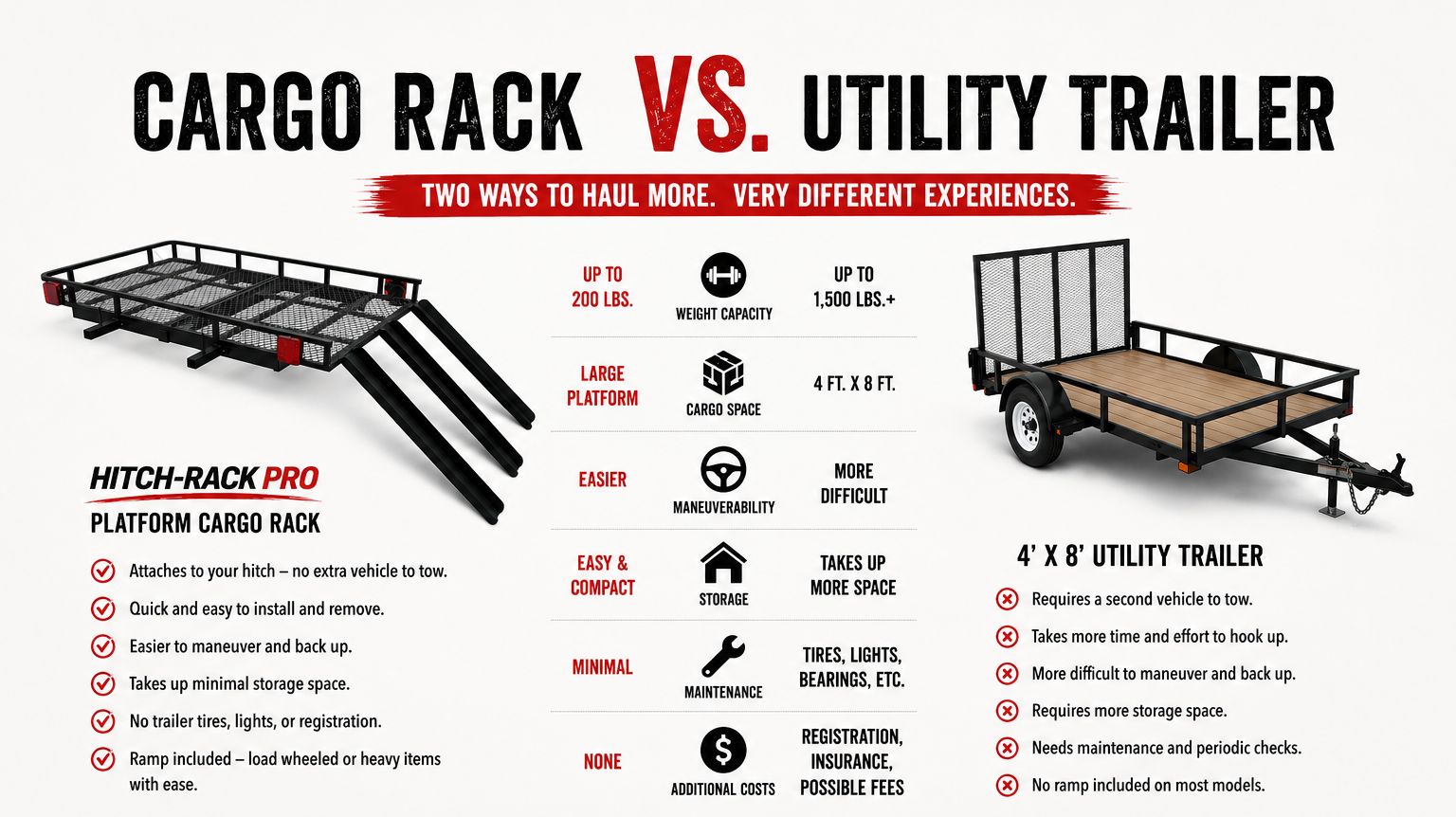
That's why Hitch-Rack Pro carriers are designed with e-bikes and e-trikes in mind, rather than treating them like conventional bicycles.
When you're transporting an expensive electric bike or trike at highway speeds, choosing equipment that's appropriate for the load isn't simply about convenience. It's an important part of transporting your ride properly.
Hitch Carrier vs. Roof Carrier: Which Should You Choose?
For a lightweight conventional bicycle, either system may work well.
For an e-bike, the decision increasingly favors a hitch-mounted carrier as the bicycle gets heavier.
For an e-trike, a hitch-mounted platform designed specifically for the size and weight of the trike is usually the much more practical solution.
Here's the simplest way to think about it:
Choose a roof carrier when: you have a lighter bike, compatible roof equipment, want unrestricted rear access, and are comfortable lifting the bicycle overhead.
Choose a hitch carrier when: you're transporting a heavier e-bike or e-trike, want a lower loading height, prefer easier loading, or need equipment specifically designed for larger electric cycles.
Before You Buy Any E-Bike or E-Trike Carrier
Don't choose a carrier based on the bike alone.
You need to make sure the bike, carrier, hitch, and vehicle all work together as a system.
Before purchasing, know the weight and dimensions of your e-bike or e-trike and verify the applicable ratings for your vehicle and hitch.
For an e-trike, measurements such as overall width, wheelbase, tire width, and total weight can be especially important.
At Hitch-Rack Pro, our goal is to make transporting e-bikes and e-trikes simpler, safer, and more convenient—so getting your ride to the destination doesn't become the hardest part of the trip.
Frequently Asked Questions
Are hitch racks better than roof racks for e-bikes?
For heavier e-bikes, hitch-mounted carriers are often more practical because they keep the loading height closer to the ground. The best choice still depends on the bike's weight, the carrier's rating, and your vehicle.
Can a regular bike rack carry an e-trike?
Most standard bicycle racks aren't designed around the width, weight, or three-wheel configuration of an e-trike. Look for a carrier specifically rated and designed for your type of trike.
Do I need a 2-inch hitch for an e-trike carrier?
That depends on the carrier, vehicle, and load. Follow the carrier manufacturer's requirements and verify your vehicle and receiver hitch ratings before transporting an e-trike.
Is a loading ramp worth it for an e-bike or e-trike?
For a heavy electric bike or trike, a ramp can significantly reduce the amount of lifting required during loading and unloading. It can be particularly useful for riders who frequently transport their cycle or load it without assistance.
What measurements do I need before buying an e-trike carrier?
Start with the trike's total weight, overall width, wheelbase, tire width, and relevant wheel dimensions. Then compare those measurements with the carrier specifications and verify the vehicle and hitch capacities.


Comments
Do you have a rack for 2 bikes only?